
Ch 16: Traveling Waves
Knight Calc - Physics for Scientists and Engineers 5th Edition
Knight Calc5th EditionPhysics for Scientists and EngineersISBN: 9780137344796Not the one you use?Change textbook
Chapter 16, Problem 62

A string that is under 50.0 N of tension has linear density 5.0 g/m. A sinusoidal wave with amplitude 3.0 cm and wavelength 2.0 m travels along the string. What is the maximum speed of a particle on the string?

Verified step by step guidance
1
Step 1: Convert the linear density from grams per meter to kilograms per meter. Since 1 g = 0.001 kg, the linear density becomes \( \mu = 5.0 \times 10^{-3} \, \text{kg/m} \).
Step 2: Calculate the wave speed \( v \) using the formula \( v = \sqrt{\frac{T}{\mu}} \), where \( T \) is the tension in the string (50.0 N) and \( \mu \) is the linear density. Substitute the values into the formula.
Step 3: Determine the angular frequency \( \omega \) of the wave using the relationship \( \omega = \frac{2\pi v}{\lambda} \), where \( \lambda \) is the wavelength (2.0 m) and \( v \) is the wave speed calculated in Step 2.
Step 4: The maximum speed of a particle on the string is given by \( v_{\text{max}} = \omega A \), where \( A \) is the amplitude of the wave (3.0 cm or 0.03 m) and \( \omega \) is the angular frequency calculated in Step 3.
Step 5: Substitute the values of \( \omega \) and \( A \) into the formula \( v_{\text{max}} = \omega A \) to express the maximum speed of a particle on the string.

Verified video answer for a similar problem:

This video solution was recommended by our tutors as helpful for the problem above.
Video duration:
2m
Was this helpful?

Key Concepts

Here are the essential concepts you must grasp in order to answer the question correctly.

Tension in a String

Tension refers to the force exerted along the length of a string or rope, which affects how waves propagate through it. In this context, the tension of 50.0 N influences the wave speed and particle motion on the string. Higher tension generally results in faster wave propagation.
Recommended video:
Guided course
04:39
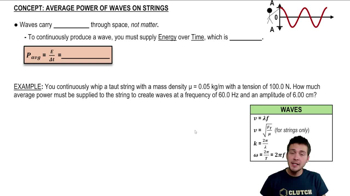
Energy & Power of Waves on Strings

Linear Density

Linear density is defined as the mass per unit length of a string, typically expressed in grams per meter (g/m). It plays a crucial role in determining the wave speed on the string, as it affects how much mass is being moved by the tension. In this case, a linear density of 5.0 g/m will influence the maximum speed of particles on the string.
Recommended video:
Guided course
8:13
Intro to Density

Wave Speed and Particle Motion

The speed of a wave on a string is determined by the tension and linear density, described by the formula v = √(T/μ), where T is tension and μ is linear density. The maximum speed of a particle on the string is related to the wave's amplitude and frequency. Understanding these relationships is essential for calculating the maximum speed of particles in the given wave scenario.
Recommended video:
Guided course
07:19
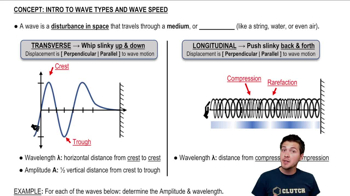
Intro to Waves and Wave Speed
Related Practice
Textbook Question

A wave on a string is described by D(x,t)=(2.00cm)×sin[(12.57rad/m)x(638rad/s)t]D(x,t) = (2.00 \, \text{cm}) \times \sin[(12.57 \, \text{rad/m})x - (638 \, \text{rad/s}) t], where xx is in mm and tt in ss. The linear density of the string is 5.00 g/m5.00\text{ g/m}. What are The maximum speed of a point on the string?

1115
views
Textbook Question

FIGURE P16.57 shows a snapshot graph of a wave traveling to the right along a string at 45 m/s. At this instant, what is the velocity of points 1, 2, and 3 on the string?

1102
views
Textbook Question

The string in FIGURE P16.59 has linear density μ. Find an expression in terms of M, μ, and θ for the speed of waves on the string.

725
views
Textbook Question

A 1000 Hz sound wave traveling through 20°C air causes the pressure to oscillate around atmospheric pressure by ±0.050%. What is the maximum speed of an oscillating air molecule? Give your answer in mm/s.

699
views
Textbook Question

LASIK eye surgery uses pulses of laser light to shave off tissue from the cornea, reshaping it. A typical LASIK laser emits a 1.0-mm-diameter laser beam with a wavelength of 193 nm. Each laser pulse lasts 15 ns and contains 1.0 mJ of light energy. During the very brief time of the pulse, what is the intensity of the light wave?

1082
views
Textbook Question

A battery-powered siren emits 0.50 W of sound power at 1000 Hz. It is dropped from 100 m directly over your head on a 20°C day. 4.0 s after it is released, what are (a) the frequency and (b) the sound intensity level you hear?

81
views