
Textbook Question
Two pulses are moving in opposite directions at 1.0 cm/s on a taut string, as shown in Fig. E15.34. Each square is 1.0 cm.
<Image>
Sketch the shape of the string at the end of 6.0 s.
2169
views

 Verified step by step guidance
 07:19
07:19
 06:28 06:28
Two pulses are moving in opposite directions at 1.0 cm/s on a taut string, as shown in Fig. E15.34. Each square is 1.0 cm.
<Image>
Sketch the shape of the string at the end of 6.0 s.
A wire with mass 40.0 g is stretched so that its ends are tied down at points 80.0 cm apart. The wire vibrates in its fundamental mode with frequency 60.0 Hz and with an amplitude at the antinodes of 0.300 cm. What is the speed of propagation of transverse waves in the wire?
Two pulses are moving in opposite directions at 1.0 cm/s on a taut string, as shown in Fig. E15.34. Each square is 1.0 cm. <IMAGE> Sketch the shape of the string at the end of 7.0 s.
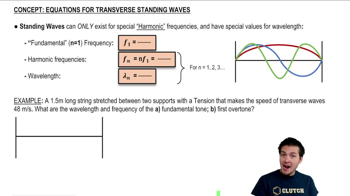
A 1.50-m-long rope is stretched between two supports with a tension that makes the speed of transverse waves 62.0 m/s.What are the wavelength and frequency of the fundamental?
A piano tuner stretches a steel piano wire with a tension of 800 N. The steel wire is 0.400 m long and has a mass of 3.00 g. What is the frequency of its fundamental mode of vibration?
A 1.50-m-long rope is stretched between two supports with a tension that makes the speed of transverse waves 62.0 m/s.What are the wavelength and frequency of the fourth harmonic?