
Ch 36: Diffraction
Young & Freedman Calc - University Physics 14th Edition
Young & Freedman Calc14th EditionUniversity PhysicsISBN: 9780321973610Not the one you use?Change textbook
Chapter 36, Problem 26

If a diffraction grating produces a third-order bright spot for red light (of wavelength 700 nm) at 65.0° from the central maximum, at what angle will the second-order bright spot be for violet light (of wavelength 400 nm)?

Verified step by step guidance
1
Step 1: Recall the diffraction grating equation: n \(\lambda\) = d \(\sin\) \(\theta\), where n is the order of the bright spot, \(\lambda\) is the wavelength of light, d is the spacing between adjacent slits in the grating, and \(\theta\) is the diffraction angle.
Step 2: Use the given information for the red light to calculate the grating spacing d. For the third-order bright spot (n = 3) of red light (\(\lambda\) = 700 \(\text{ nm}\) = 700 \(\times\) 10^{-9} \(\text{ m}\)) at an angle of \(\theta\) = 65.0^\(\circ\), rearrange the equation to solve for d: d = \(\frac{n \lambda}{\sin \theta}\).
Step 3: Once d is determined, use it to find the angle for the second-order bright spot (n = 2) of violet light (\(\lambda\) = 400 \(\text{ nm}\) = 400 \(\times\) 10^{-9} \(\text{ m}\)). Rearrange the diffraction equation to solve for \(\theta\): \(\sin\) \(\theta\) = \(\frac{n \lambda}{d}\).
Step 4: Substitute the values of n = 2, \(\lambda\) = 400 \(\times\) 10^{-9} \(\text{ m}\), and the previously calculated d into the equation \(\sin\) \(\theta\) = \(\frac{n \lambda}{d}\). Compute \(\sin\) \(\theta\).
Step 5: Use the inverse sine function to find the angle \(\theta\): \(\theta\) = \(\arcsin\)(\(\sin\) \(\theta\)). This will give the angle for the second-order bright spot of violet light.

Verified video answer for a similar problem:

This video solution was recommended by our tutors as helpful for the problem above.
Video duration:
5m
Was this helpful?

Key Concepts

Here are the essential concepts you must grasp in order to answer the question correctly.

Diffraction Grating

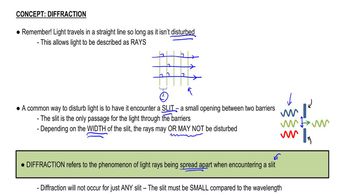
A diffraction grating is an optical component with a periodic structure that disperses light into its component wavelengths. It works on the principle of interference, where light waves overlap and combine, creating bright and dark spots at specific angles. The angle at which these spots appear depends on the wavelength of the light and the spacing of the grating lines.
Recommended video:

Order of Diffraction

The order of diffraction refers to the integer (m) that indicates the number of wavelengths by which the path difference between light waves contributes to constructive interference. For example, the first-order bright spot corresponds to m=1, the second-order to m=2, and so on. Each order appears at a specific angle determined by the wavelength of light and the grating spacing.
Recommended video:

Wavelength and Angle Relationship

The relationship between wavelength and angle in diffraction can be described by the grating equation: d sin(θ) = mλ, where d is the grating spacing, θ is the angle of the bright spot, m is the order of diffraction, and λ is the wavelength. This equation allows us to calculate the angle for different wavelengths and orders, illustrating how varying wavelengths produce different diffraction patterns.
Recommended video:
Guided course
03:43
Relationships Between Force, Field, Energy, Potential
Related Practice
Textbook Question

The wavelength range of the visible spectrum is approximately 380–750 nm. White light falls at normal incidence on a diffraction grating that has 350 slits/mm. Find the angular width of the visible spectrum in the first order.

318
views
Textbook Question

Laser light of wavelength 500.0 nm illuminates two identical slits, producing an interference pattern on a screen 90.0 cm from the slits. The bright bands are 1.00 cm apart, and the third bright bands on either side of the central maximum are missing in the pattern. Find the width and the separation of the two slits.

2071
views
1
rank
Textbook Question

When laser light of wavelength 632.8 nm passes through a diffraction grating, the first bright spots occur at ±17.8° from the central maximum. (a) What is the line density (in lines/cm) of this grating? (b) How many additional bright spots are there beyond the first bright spots, and at what angles do they occur?

383
views
Textbook Question

If a diffraction grating produces its third-order bright band at an angle of 78.4° for light of wavelength 681 nm, find (a) the number of slits per centimeter for the grating and (b) the angular location of the first-order and second-order bright bands. (c) Will there be a fourth-order bright band? Explain.

261
views
Textbook Question

(a) What is the wavelength of light that is deviated in the first order through an angle of 13.5° by a transmission grating having 5000 slits/cm? (b) What is the second-order deviation of this wavelength? Assume normal incidence.

287
views
Textbook Question

A laser beam of wavelength λ = 632.8 nm shines at normal incidence on the reflective side of a compact disc. (a) The tracks of tiny pits in which information is coded onto the CD are 1.60 μm apart. For what angles of reflection (measured from the normal) will the intensity of light be maximum? (b) On a DVD, the tracks are only 0.740 μm apart. Repeat the calculation of part (a) for the DVD.

1453
views