Ch 24: Capacitance and Dielectrics
Young & Freedman Calc - University Physics 14th Edition
Young & Freedman Calc14th EditionUniversity PhysicsISBN: 9780321973610Not the one you use?Change textbook
Chapter 24, Problem 14b

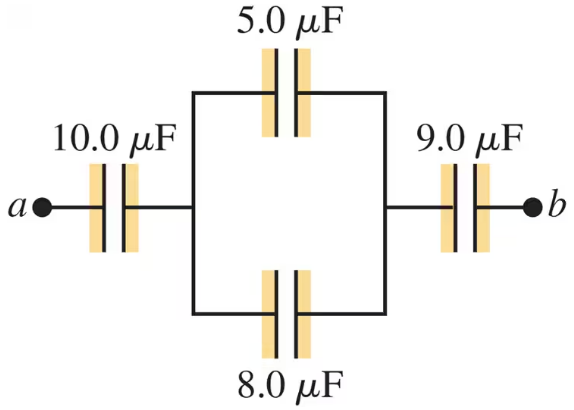
Figure E24.1424.14 shows a system of four capacitors, where the potential difference across ab is 50.050.0 V. How much charge is stored by this combination of capacitors?
Diagram of four capacitors: 10.0 µF, 5.0 µF, 8.0 µF, 9.0 µF, connected between points a and b, with 50.0 V across ab.

Verified step by step guidance
1
Identify the configuration of the capacitors. Capacitors C2 and C3 are in parallel, and their combination is in series with C1 and C4.
Calculate the equivalent capacitance of the parallel capacitors C2 and C3. Use the formula for capacitors in parallel: C_parallel = C2 + C3.
Calculate the equivalent capacitance of the series combination of C1, C_parallel (from step 2), and C4. Use the formula for capacitors in series: 1/C_series = 1/C1 + 1/C_parallel + 1/C4.
Determine the total charge stored by the combination using the formula Q = C_total * V, where C_total is the equivalent capacitance from step 3 and V is the potential difference across ab (50.0 V).
Ensure all units are consistent and verify each calculation step to ensure accuracy in determining the charge stored by the capacitors.

Verified video answer for a similar problem:

This video solution was recommended by our tutors as helpful for the problem above.
Video duration:
2m
Was this helpful?

Key Concepts

Here are the essential concepts you must grasp in order to answer the question correctly.

Capacitance

Capacitance is the ability of a capacitor to store charge per unit voltage, measured in farads (F). It is defined by the formula C = Q/V, where C is capacitance, Q is the charge stored, and V is the voltage across the capacitor. In this problem, the individual capacitances of the capacitors (10.0 µF, 5.0 µF, 8.0 µF, and 9.0 µF) are crucial for calculating the total capacitance of the system.
Recommended video:
Guided course
08:02
Capacitors & Capacitance (Intro)

Series and Parallel Capacitors

Capacitors can be connected in series or parallel, affecting the total capacitance of the circuit. In series, the total capacitance (C_total) is given by 1/C_total = 1/C1 + 1/C2 + ... for each capacitor. In parallel, the total capacitance is the sum of individual capacitances: C_total = C1 + C2 + .... Understanding how to combine these capacitors in the given configuration is essential for solving the problem.
Recommended video:
Guided course
09:51
Combining Capacitors in Series & Parallel

Charge Storage in Capacitors

The charge stored in a capacitor is directly proportional to the capacitance and the voltage across it, as described by the equation Q = C × V. In this scenario, with a total capacitance calculated from the configuration and a potential difference of 50.0 V, this relationship will allow us to determine the total charge stored in the combination of capacitors.
Recommended video:
Guided course
06:07
Point Charge Inside Capacitor
Related Practice
Textbook Question

For the system of capacitors shown in Fig. E24.1624.16, find the equivalent capacitance between bb and cc.

2719
views
1
rank
Textbook Question

A parallel-plate air capacitor is to store charge of magnitude 240.0240.0 pC on each plate when the potential difference between the plates is 42.042.0 V.

(a) If the area of each plate is 6.806.80 cm2, what is the separation between the plates?

(b) If the separation between the two plates is double the value calculated in part (a), what potential difference is required for the capacitor to store charge of magnitude 240.0240.0 pC on each plate?

2539
views
Textbook Question

Figure E24.1424.14 shows a system of four capacitors, where the potential difference across ab is 50.050.0 V. How much charge is stored in each of the 10.010.0-μ\(\mu\)F and the 9.09.0-μ\(\mu\)F capacitors?

3272
views
Textbook Question

In Fig. E24.2024.20, C1=6.00C_1=6.00 μ\(\mu\)F, C2=3.00C_2 = 3.00 μ\(\mu\)F, and C3=5.00C_3 = 5.00 μ\(\mu\)F. The capacitor network is connected to an applied potential VabV_{ab}.

(a) After the charges on the capacitors have reached their final values, the charge on C2C_2 is 30.030.0 mC. What are the charges on capacitors C1C_1 and C3C_3?

(b) What is the applied voltage VabV_{ab}?

4327
views
Textbook Question

A capacitor is made from two hollow, coaxial, iron cylinders, one inside the other. The inner cylinder is negatively charged and the outer is positively charged; the magnitude of the charge on each is 10.010.0 pC. The inner cylinder has radius 0.500.50 mm, the outer one has radius 5.005.00 mm, and the length of each cylinder is 18.018.0 cm.

(a) What is the capacitance?

(b) What applied potential difference is necessary to produce these charges on the cylinders?

1975
views
Textbook Question

A spherical capacitor contains a charge of 3.303.30 nC when connected to a potential difference of 220220 V. If its plates are separated by vacuum and the inner radius of the outer shell is 4.004.00 cm, calculate: (a) the capacitance; (b) the radius of the inner sphere; (c) the electric field just outside the surface of the inner sphere.

2452
views