
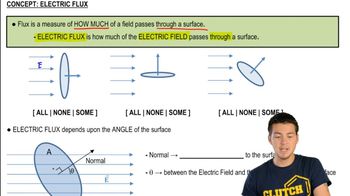
A flat sheet of paper of area m2 is oriented so that the normal to the sheet is at an angle of ° to a uniform electric field of magnitude N/C. For what angle between the normal to the sheet and the electric field is the magnitude of the flux through the sheet (i) largest and (ii) smallest? Explain your answers.
A hemispherical surface with radius in a region of uniform electric field has its axis aligned parallel to the direction of the field. Calculate the flux through the surface.
Verified step by step guidance
Verified video answer for a similar problem:
Key Concepts
Electric Flux
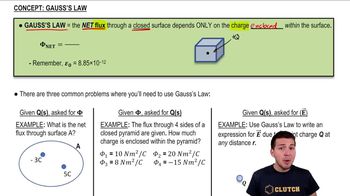
Gauss's Law
Surface Area of a Hemisphere
The nuclei of large atoms, such as uranium, with protons, can be modeled as spherically symmetric spheres of charge. The radius of the uranium nucleus is approximately m. What is the electric field this nucleus produces just outside its surface?
You measure an electric field of N/C at a distance of m from a point charge. There is no other source of electric field in the region other than this point charge.
(a) What is the electric flux through the surface of a sphere that has this charge at its center and that has radius m?
(b) What is the magnitude of this charge?
A charged paint is spread in a very thin uniform layer over the surface of a plastic sphere of diameter cm, giving it a charge of C. Find the electric field just outside the paint layer;
A flat sheet of paper of area m2 is oriented so that the normal to the sheet is at an angle of ° to a uniform electric field of magnitude N/C.
(a) Find the magnitude of the electric flux through the sheet.
(b) Does the answer to part (a) depend on the shape of the sheet? Why or why not?
A charged paint is spread in a very thin uniform layer over the surface of a plastic sphere of diameter cm, giving it a charge of C. Find the electric field just inside the paint layer.
