
Ch 40: Quantum Mechanics I: Wave Functions
Young & Freedman Calc - University Physics 14th Edition
Young & Freedman Calc14th EditionUniversity PhysicsISBN: 9780321973610Not the one you use?Change textbook
Chapter 40, Problem 5

Consider a wave function given by ψ(x)=Asinkxψ(x) = A sinkx, where k=2π/λ k = 2π/λ and AA is a real constant.
(a) For what values of xx is there the highest probability of finding the particle described by this wave function? Explain.
(b) For which values of xx is the probability zero? Explain.

Verified step by step guidance
1
Step 1: Understand the wave function ψ(x) = A sin(kx). The probability density of finding the particle is proportional to the square of the wave function, |ψ(x)|². Since ψ(x) involves a sine function, its square will depend on the amplitude of the sine wave.
Step 2: Recall the properties of the sine function. The sine function, sin(kx), oscillates between -1 and 1. The square of the sine function, sin²(kx), will oscillate between 0 and 1. The highest probability corresponds to the maximum value of sin²(kx), which is 1.
Step 3: To find the values of x where the probability is highest, identify where sin²(kx) = 1. This occurs when sin(kx) = ±1. For sin(kx) = ±1, kx must equal (2n+1)π/2, where n is an integer. Substitute k = 2π/λ to express x in terms of λ: x = (2n+1)λ/4.
Step 4: To find the values of x where the probability is zero, identify where sin²(kx) = 0. This occurs when sin(kx) = 0. For sin(kx) = 0, kx must equal nπ, where n is an integer. Substitute k = 2π/λ to express x in terms of λ: x = nλ/2.
Step 5: Summarize the results. The highest probability of finding the particle occurs at x = (2n+1)λ/4, and the probability is zero at x = nλ/2, where n is an integer. These positions correspond to the maxima and nodes of the sine wave, respectively.

Verified video answer for a similar problem:

This video solution was recommended by our tutors as helpful for the problem above.
Was this helpful?

Key Concepts

Here are the essential concepts you must grasp in order to answer the question correctly.

Wave Function

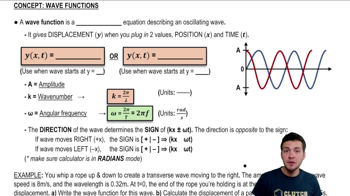
A wave function, denoted as ψ(x), describes the quantum state of a particle in quantum mechanics. It contains all the information about the system and is used to calculate probabilities of finding a particle in a particular state. The square of the absolute value of the wave function, |ψ(x)|², gives the probability density of finding the particle at position x.
Recommended video:
Guided course
08:30
Intro to Wave Functions

Probability Density

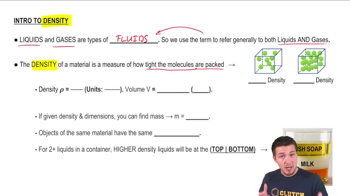
Probability density is a measure that describes the likelihood of finding a particle in a specific location in space. For a wave function ψ(x) = A sin(kx), the probability density is given by |ψ(x)|² = A² sin²(kx). The peaks of this function indicate where the particle is most likely to be found, while the zeros indicate locations where the probability of finding the particle is zero.
Recommended video:
Guided course
8:13
Intro to Density

Nodes and Antinodes

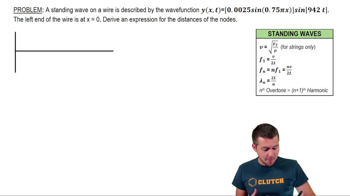
In the context of wave functions, nodes are points where the wave function equals zero, resulting in zero probability of finding the particle. Antinodes, on the other hand, are points where the wave function reaches its maximum value, indicating the highest probability of finding the particle. For the function ψ(x) = A sin(kx), nodes occur at integer multiples of λ/2, while antinodes occur at odd multiples of λ/4.
Recommended video:
Related Practice
Textbook Question

An electron is moving as a free particle in the x-x-direction with momentum that has magnitude 4.50×10244.50\(\times\)10^{-24} kg*m/s. Let k2=3k1=3kk_2 = 3k_1 = 3k. At t=0 t = 0, the probability distribution func­tion Ψ(x,t)2|Ψ(x, t)|^2 has a maximum at x=0x = 0.

(a) What is the smallest positive value of xx for which the probability distribution function has a maximum at time t=2πωt=\(\frac{2\pi}{\omega}\), where ω=hk2/2mω = hk^2/2m?

(b) From your result in part (a), what is the average speed with which the probability distribution is moving in the +x+x­-direction?

44
views
Textbook Question

Let ψ1ψ_1 and ψ2ψ_2 be two solutions of Eq. (40.2340.23) [h22md2ψ(x)dx2+U(x)ψ(x)=Eψ(x)-\(\frac{h^2}{2m}\]\frac{d^2\psi(x)}{dx^2}\)+U\(\left\)(x\(\right\))\(\psi\[\left\)(x\(\right\))=E\(\psi\]\left\)(x\(\right\))] with energies E1E_1 and E2E_2 respectively, where E1E2E_1≠E_2. Is ψ=Aψ1+Bψ2ψ = Aψ_1 + Bψ_2, where AA and BB are nonzero constants, a solution to Eq. (40.2340.23)? Explain your answer.

63
views
Textbook Question

A particle in a box is a billiard ball (m=0.20m = 0.20 kg) and the box has a width of 1.31.3 m, the size of a billiard table. (Assume that the billiard ball slides without friction rather than rolls; that is, ignore the rotational kinetic energy.) What is the difference in energy between the n=2n = 2 and n=1n = 1 levels? Are quantum­ mechanical effects important for the game of billiards?

89
views
Textbook Question

A particle is described by a wave function ψ(x)=Aeαx2\(\psi\)(x)=Ae^{-\(\alpha\) x^2}, where AA and αα are real, positive constants. If the value of αα is increased, what effect does this have on (a) the particle’s uncer­tainty in position and (b) the particle’s uncertainty in momentum? Explain your answers.

59
views
Textbook Question

(a) Find the lowest energy level for a particle in a box if the particle is a billiard ball (m=0.20m = 0.20 kg) and the box has a width of 1.31.3 m, the size of a billiard table. (Assume that the billiard ball slides without friction rather than rolls; that is, ignore the rotational kinetic energy.)

(b) Since the energy in part (a) is all kinetic, to what speed does this correspond? How much time would it take at this speed for the ball to move from one side of the table to the other?

44
views
Textbook Question

A free particle moving in one dimension has wave function ψ(x,t)=A[ei(kxωt)ei(2kx4ωt)]\(\psi\)(x,t)=A[e^{i\(\left\)(kx-\(\omega\) t\(\right\))}-e^{i(2kx-4\(\omega\) t)}] where kk and vv are positive real constants.

(a) At t=0 t = 0, what are the two smallest positive values of xx for which the probability function ψ(x,t)2 |ψ(x,t)|^2 is a maximum?

(b) Repeat part (a) for time t=2πωt=\(\frac{2\pi}{\omega}\).

78
views