
Textbook Question
A particle moves from A to D in FIGURE EX10.36 while experiencing force F = (6i + 8j) N. How much work does the force do if the particle follows path ACD. Is this a conservative force? Explain.
2197
views

 Verified step by step guidance
 06:58
06:58
 05:14
05:14 06:23
06:23A particle moves from A to D in FIGURE EX10.36 while experiencing force F = (6i + 8j) N. How much work does the force do if the particle follows path ACD. Is this a conservative force? Explain.
A particle moving along the y-axis is in a system with potential energy U = 4y3 J, where y is in m. What is the y-component of the force on the particle at y = 0 m, 1 m, and 2 m?
A particle moving along the x-axis is in a system that has potential energy U = x3 - 3x J, where x is in m. For each, is it a point of stable or unstable equilibrium?
A 50 g mass is attached to a light, rigid, 75-cm-long rod. The other end of the rod is pivoted so that the mass can rotate in a vertical circle. What speed does the mass need at the bottom of the circle to barely make it over the top of the circle?
A 50 g ice cube can slide up and down a frictionless 30° slope. At the bottom, a spring with spring constant 25 N/m is compressed 10 cm and used to launch the ice cube up the slope. How high does it go above its starting point?
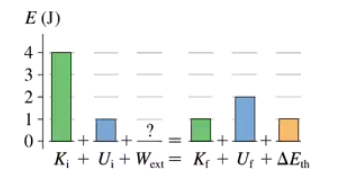
A cable with 20.0 N of tension pulls straight up on a 1.50 kg block that is initially at rest. What is the block's speed after being lifted 2.00 m? Solve this problem using work and energy.