Ch 34: Geometric Optics
Young & Freedman Calc - University Physics 14th Edition
Young & Freedman Calc14th EditionUniversity PhysicsISBN: 9780321973610Not the one you use?Change textbook
Chapter 34, Problem 60a

Resolution of a Microscope. The image formed by a microscope objective with a focal length of 5.00 mm is 160 mm from its second focal point. The eyepiece has a focal length of 26.0 mm. What is the angular magnification of the microscope?

Verified step by step guidance
1
Determine the magnification of the objective lens. The magnification of the objective lens \( M_{\text{objective}} \) is given by \( M_{\text{objective}} = \frac{L}{f_{\text{objective}}} \), where \( L \) is the distance between the image formed by the objective lens and its second focal point (160 mm in this case), and \( f_{\text{objective}} \) is the focal length of the objective lens (5.00 mm). Substitute the values into the formula.
Calculate the angular magnification of the eyepiece. The angular magnification of the eyepiece \( M_{\text{eyepiece}} \) is given by \( M_{\text{eyepiece}} = \frac{25\,\text{cm}}{f_{\text{eyepiece}}} \), where \( f_{\text{eyepiece}} \) is the focal length of the eyepiece (26.0 mm or 2.6 cm). Substitute the values into the formula.
Combine the magnifications of the objective lens and the eyepiece to find the total angular magnification of the microscope. The total angular magnification \( M_{\text{total}} \) is given by \( M_{\text{total}} = M_{\text{objective}} \times M_{\text{eyepiece}} \). Use the results from the previous steps to calculate this.
Ensure that all units are consistent throughout the calculations. For example, convert all distances to the same unit (e.g., centimeters or millimeters) before performing the calculations.
Review the assumptions made in the problem, such as the relaxed eye condition (near point at 25 cm), and confirm that the calculations align with these assumptions.

Verified video answer for a similar problem:

This video solution was recommended by our tutors as helpful for the problem above.
Video duration:
6m
Was this helpful?

Key Concepts

Here are the essential concepts you must grasp in order to answer the question correctly.

Angular Magnification

Angular magnification is a measure of how much larger an object appears when viewed through an optical instrument, such as a microscope. It is defined as the ratio of the angle subtended by the image at the eye to the angle subtended by the object at the same eye when viewed directly. This concept is crucial for understanding how effectively a microscope can enlarge an image for detailed observation.
Recommended video:
Guided course
12:12
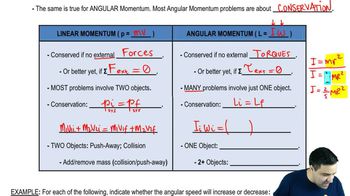
Conservation of Angular Momentum

Focal Length

Focal length is the distance from the lens to the point where parallel rays of light converge to a single point, known as the focal point. In microscopes, both the objective and eyepiece lenses have specific focal lengths that determine their ability to magnify and resolve images. Understanding focal length is essential for calculating the overall magnification and performance of the microscope.
Recommended video:
Guided course
10:54
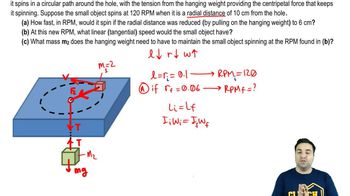
Spinning on a string of variable length

Lens Formula

The lens formula relates the object distance, image distance, and focal length of a lens, typically expressed as 1/f = 1/v - 1/u, where f is the focal length, v is the image distance, and u is the object distance. This formula is fundamental in optics for determining how lenses form images and is particularly relevant in calculating the effective magnification of a microscope based on its components.
Recommended video:
05:38
Lens Maker Equation