Textbook Question
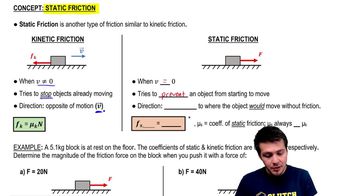
Suppose you are standing on a train accelerating at 0.20 g. What minimum coefficient of static friction must exist between your feet and the floor if you are not to slide?
1351
views

 Giancoli Douglas 5th editionCh. 05 - Using Newton's Laws: Friction, Circular Motion, Drag ForcesProblem 5.39
 Verified step by step guidance
 08:11
08:11
 06:48
06:48 07:46
07:46Suppose you are standing on a train accelerating at 0.20 g. What minimum coefficient of static friction must exist between your feet and the floor if you are not to slide?
Show that if a skier moves at constant speed straight down a slope of angle θ (Example 5–6), then the coefficient of kinetic friction between skis and snow is μₖ = tanθ. Ignore air resistance.
Piles of snow on slippery roofs can become dangerous projectiles as they melt. Consider a chunk of snow at the ridge of a roof with a slope of 24°. As the snow begins to melt, the coefficient of static friction decreases and the snow finally slips. Assuming that the distance from a chunk of snow to the edge of the roof is 6.0 m and the coefficient of kinetic friction is 0.20, calculate the speed of the snow chunk when it slides off the roof.
Police investigators, examining the scene of an accident involving a car and an old truck, measure 72-m-long skid marks for the truck, which nearly came to a stop before colliding with the car at rest. The coefficient of kinetic friction between rubber and the pavement is about 0.80. Estimate the initial speed of the truck assuming a level road.