Ch 38: Quantization
Knight Calc - Physics for Scientists and Engineers 5th Edition
Knight Calc5th EditionPhysics for Scientists and EngineersISBN: 9780137344796Not the one you use?Change textbook
Chapter 38, Problem 72b

Consider an electron undergoing cyclotron motion in a magnetic field. According to Bohr, the electron’s angular momentum must be quantized in units of ℏ. Compute the first four allowed radii in a 1.0 T magnetic field.

Verified step by step guidance
1
Step 1: Begin by understanding the quantization condition for angular momentum. According to Bohr's quantization rule, the angular momentum of the electron is given by \( L = n \hbar \), where \( n \) is a positive integer (quantum number), and \( \hbar \) is the reduced Planck's constant.
Step 2: Relate the angular momentum \( L \) to the cyclotron motion of the electron. The angular momentum for circular motion is \( L = m_e v r \), where \( m_e \) is the mass of the electron, \( v \) is its velocity, and \( r \) is the radius of the circular orbit.
Step 3: Use the force balance for cyclotron motion. The centripetal force is provided by the Lorentz force due to the magnetic field \( B \): \( m_e v^2 / r = e v B \), where \( e \) is the charge of the electron. Simplify this to \( v = e B r / m_e \).
Step 4: Substitute \( v \) from the force balance equation into the angular momentum expression \( L = m_e v r \). This gives \( L = m_e (e B r / m_e) r = e B r^2 \). Equating this to Bohr's quantization condition \( L = n \hbar \), we find \( e B r^2 = n \hbar \). Solve for \( r \): \( r = \sqrt{(n \hbar) / (e B)} \).
Step 5: Compute the first four allowed radii by substituting \( n = 1, 2, 3, 4 \), \( \hbar \approx 1.054 \times 10^{-34} \, \mathrm{J \cdot s} \), \( e \approx 1.602 \times 10^{-19} \, \mathrm{C} \), \( B = 1.0 \, \mathrm{T} \), and \( m_e \approx 9.109 \times 10^{-31} \, \mathrm{kg} \) into the formula \( r = \sqrt{(n \hbar) / (e B)} \).

Verified video answer for a similar problem:

This video solution was recommended by our tutors as helpful for the problem above.
Was this helpful?

Key Concepts

Here are the essential concepts you must grasp in order to answer the question correctly.

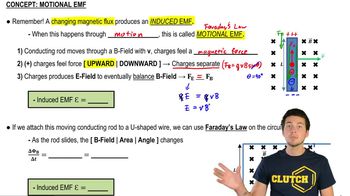
Cyclotron Motion

Cyclotron motion refers to the circular motion of a charged particle, such as an electron, in a magnetic field. The magnetic force acts as a centripetal force, causing the particle to move in a circular path. The frequency of this motion, known as the cyclotron frequency, is directly proportional to the strength of the magnetic field and the charge-to-mass ratio of the particle.
Recommended video:

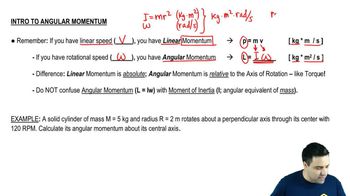
Quantization of Angular Momentum

In quantum mechanics, the angular momentum of a particle is quantized, meaning it can only take on discrete values. For an electron in a magnetic field, Bohr's model states that the angular momentum must be an integer multiple of ℏ (reduced Planck's constant). This quantization leads to specific allowed energy levels and corresponding radii for the electron's orbit.
Recommended video:
Guided course
06:18
Intro to Angular Momentum

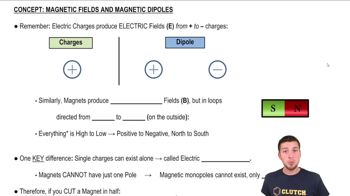
Magnetic Field Strength

Magnetic field strength, measured in teslas (T), is a measure of the magnetic force experienced by a charged particle. In this context, a 1.0 T magnetic field indicates a strong magnetic influence on the electron's motion. The strength of the magnetic field directly affects the radius of the electron's cyclotron motion, as stronger fields result in smaller radii for the allowed orbits.
Recommended video:
Guided course
05:30
Magnetic Fields and Magnetic Dipoles