
Julie drives 100 mi to Grandmother's house. On the way to Grandmother's, Julie drives half the distance at 40 mph and half the distance at 60 mph. On her return trip, she drives half the time at 40 mph and half the time at 60 mph. What is Julie's average speed on the way to Grandmother's house?
Ch 02: Kinematics in One Dimension
Knight Calc5th EditionPhysics for Scientists and EngineersISBN: 9780137344796Not the one you use?Change textbook
Chapter 2, Problem 5a
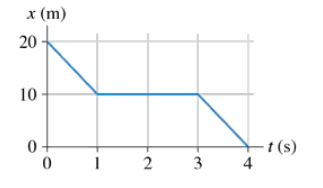
FIGURE EX2.5 shows the position graph of a particle. Draw the particle’s velocity graph for the interval .

Verified step by step guidance1
Analyze the position vs. time graph provided in the problem. Identify the key features such as slopes (positive, negative, or zero) and any changes in the slope, as these correspond to the velocity of the particle.
Recall that the velocity of a particle is the derivative of its position with respect to time, \( v(t) = \frac{dx}{dt} \). The slope of the position graph at any point gives the velocity at that time.
Break the position graph into segments where the slope is constant or changes. For each segment, determine whether the slope is positive (indicating positive velocity), negative (indicating negative velocity), or zero (indicating zero velocity).
Plot the velocity graph based on the slopes of the position graph. For example, if the slope of the position graph is constant and positive, the velocity graph will show a horizontal line at a positive value. If the slope is zero, the velocity graph will show a horizontal line at zero.
Ensure that the transitions in the velocity graph correspond to the changes in slope of the position graph. For instance, if the slope of the position graph changes abruptly, the velocity graph will show a discontinuity at that point.

Verified video answer for a similar problem:
This video solution was recommended by our tutors as helpful for the problem above.
Video duration:
5mWas this helpful?
Key Concepts
Here are the essential concepts you must grasp in order to answer the question correctly.
Position vs. Time Graphs
A position vs. time graph illustrates how the position of a particle changes over time. The slope of this graph at any point represents the velocity of the particle. A steeper slope indicates a higher velocity, while a flat slope indicates the particle is at rest. Understanding this relationship is crucial for interpreting how the particle moves.
Recommended video:
Guided course
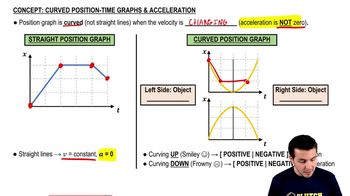
Curved Position-Time Graphs & Acceleration
Velocity
Velocity is a vector quantity that describes the rate of change of an object's position with respect to time. It has both magnitude and direction, distinguishing it from speed, which is scalar. The velocity graph can be derived from the position graph by calculating the slope of the position curve at various points, indicating how quickly and in which direction the particle is moving.
Recommended video:
Guided course
Escape Velocity
Graphical Interpretation
Graphical interpretation involves analyzing graphs to extract meaningful information about physical phenomena. In this context, converting a position graph to a velocity graph requires understanding how to represent changes in position as changes in velocity over time. This skill is essential for visualizing motion and predicting future behavior of the particle based on its current state.
Recommended video:
Guided course
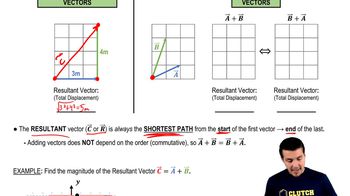
Adding Vectors Graphically
Related Practice
Textbook Question
1233
views
Textbook Question
FIGURE EX2.4 is the position-versus-time graph of a bicycle. What is the bicycle's velocity at t = 5s
971
views
Textbook Question
FIGURE EX2.4 is the position-versus-time graph of a bicycle. What is the bicycle's velocity at t = 30s?
1048
views
Textbook Question
A particle starts from at and moves with the velocity graph shown in FIGURE EX2.6. Does this particle have a turning point? If so, at what time?
629
views
Textbook Question
A particle starts from x0 = 10 m at t0 = 0 s and moves with the velocity graph shown in FIGURE EX2.6. What is the object’s position at t = 2 s and 4 s?
606
views
Textbook Question
FIGURE EX2.8 is a somewhat idealized graph of the velocity of blood in the ascending aorta during one beat of the heart. Approximately how far, in cm, does the blood move during one beat?
1326
views
