Pearson+ LogoPearson+ Logo
Ch 03: Vectors and Coordinate Systems
Knight Calc - Physics for Scientists and Engineers 5th Edition
Knight Calc5th EditionPhysics for Scientists and EngineersISBN: 9780137344796Not the one you use?Change textbook
Chapter 3, Problem 20

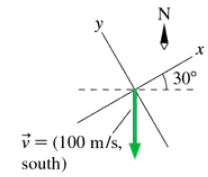
What are the x- and y-components of the velocity vector shown in FIGURE EX3.20?

Verified step by step guidance
1
Step 1: Identify the given information from the diagram. The force vector has a magnitude of 25 N and is directed at an angle of 20° from the positive x-axis. The goal is to find the x- and y-components of this vector.
Step 2: Recall the formulas for resolving a vector into its components. The x-component of the vector is given by \( F_x = F \cdot \cos(\alpha) \), and the y-component is given by \( F_y = F \cdot \sin(\alpha) \), where \( F \) is the magnitude of the vector and \( \alpha \) is the angle it makes with the positive x-axis.
Step 3: Substitute the given values into the formulas. For the x-component: \( F_x = 25 \cdot \cos(20°) \). For the y-component: \( F_y = 25 \cdot \sin(20°) \).
Step 4: Use a calculator or trigonometric tables to find the values of \( \cos(20°) \) and \( \sin(20°) \). These values will be multiplied by the magnitude of the force (25 N) to determine the components.
Step 5: Interpret the results. The x-component represents the horizontal part of the vector along the x-axis, and the y-component represents the vertical part of the vector along the y-axis. Ensure the signs of the components are consistent with the direction of the vector in the diagram.

Verified video answer for a similar problem:

This video solution was recommended by our tutors as helpful for the problem above.
Video duration:
5m
Was this helpful?

Key Concepts

Here are the essential concepts you must grasp in order to answer the question correctly.

Vector Components

Vector components are the projections of a vector along the axes of a coordinate system. In two dimensions, any vector can be broken down into its x (horizontal) and y (vertical) components using trigonometric functions. This is essential for analyzing forces, as it allows us to understand how much of the force acts in each direction.
Recommended video:
Guided course
07:30
Vector Addition By Components

Trigonometric Functions

Trigonometric functions, such as sine and cosine, relate the angles of a triangle to the ratios of its sides. For a vector at an angle, the x-component can be found using the cosine of the angle, while the y-component is found using the sine. In this case, with a 20-degree angle, these functions will help determine the respective components of the 25 N force.
Recommended video:
Guided course
08:30
Intro to Wave Functions

Force and Direction

Force is a vector quantity that has both magnitude and direction. In this problem, the force of 25 N is directed at an angle of 20 degrees from the x-axis, which indicates that it has both an upward (y) and a horizontal (x) component. Understanding the direction of the force is crucial for accurately calculating its components and analyzing the overall effect of the force in a given scenario.
Recommended video:
09:49
Direction of Current in Loop Equations