Pearson+ LogoPearson+ Logo
Ch 03: Vectors and Coordinate Systems
Knight Calc - Physics for Scientists and Engineers 5th Edition
Knight Calc5th EditionPhysics for Scientists and EngineersISBN: 9780137344796Not the one you use?Change textbook
Chapter 3, Problem 3a

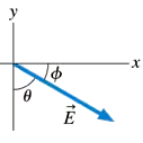
What are the x- and y-components of vector E shown in FIGURE EX3.3 in terms of the angle θ and the magnitude E?

Verified step by step guidance
1
Step 1: Identify the components of the vector. The vector shown in the figure has a magnitude E and is oriented at an angle θ with respect to the positive x-axis. The x-component and y-component of the vector can be determined using trigonometric functions.
Step 2: Use the cosine function to find the x-component. The x-component of the vector is given by the formula: Ecosθ. This is because the cosine function relates the adjacent side (x-component) to the hypotenuse (magnitude of the vector).
Step 3: Use the sine function to find the y-component. The y-component of the vector is given by the formula: Esinθ. This is because the sine function relates the opposite side (y-component) to the hypotenuse (magnitude of the vector).
Step 4: Write the vector components in terms of E and θ. The x-component is Ecosθ, and the y-component is Esinθ. These components represent the projection of the vector along the x-axis and y-axis respectively.
Step 5: Verify the components using the Pythagorean theorem. The magnitude of the vector E should satisfy the equation: E2, which is consistent with the sum of the squares of the x-component and y-component.

Verified video answer for a similar problem:

This video solution was recommended by our tutors as helpful for the problem above.
Video duration:
2m
Was this helpful?

Key Concepts

Here are the essential concepts you must grasp in order to answer the question correctly.

Vector Components

Vectors can be broken down into components along the axes of a coordinate system. For a vector A at an angle θ, the x-component (Ax) is found using the cosine function, while the y-component (Ay) is determined using the sine function. This decomposition allows for easier analysis of vector behavior in two-dimensional space.
Recommended video:
Guided course
07:30
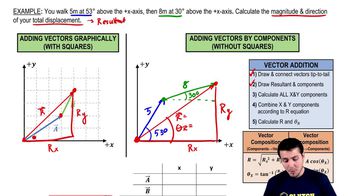
Vector Addition By Components

Trigonometric Functions

Trigonometric functions, specifically sine and cosine, relate the angles of a triangle to the ratios of its sides. In the context of vector components, cosine(θ) gives the ratio of the adjacent side (x-component) to the hypotenuse (magnitude of the vector), while sine(θ) gives the ratio of the opposite side (y-component) to the hypotenuse. These functions are essential for calculating the components of vectors.
Recommended video:
Guided course
08:30
Intro to Wave Functions

Magnitude of a Vector

The magnitude of a vector is its length and represents the overall strength or size of the vector. It is denoted as E in this context. The magnitude is crucial for determining the components of the vector, as the x- and y-components are derived from the magnitude multiplied by the respective trigonometric functions of the angle θ.
Recommended video:
Guided course
03:59
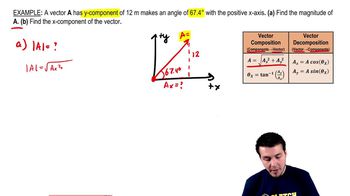
Calculating Magnitude & Components of a Vector