
Ch 04: Kinematics in Two Dimensions
Chapter 4, Problem 67

A Ferris wheel of radius R speeds up with angular acceleration starting from rest. Find expressions for the (a) velocity and (b) centripetal acceleration of a rider after the Ferris wheel has rotated through angle ∆θ.

Verified step by step guidance
1
Start by identifying the relationship between angular acceleration (α), angular displacement (Δθ), and angular velocity (ω). Use the kinematic equation for rotational motion: ω^2 = ω_0^2 + 2αΔθ. Since the Ferris wheel starts from rest, ω_0 = 0, so the equation simplifies to ω = \sqrt{2αΔθ}. This gives the angular velocity after the wheel has rotated through angle Δθ.
To find the linear velocity (v) of the rider, use the relationship between linear velocity and angular velocity: v = ωR, where R is the radius of the Ferris wheel. Substitute ω = \sqrt{2αΔθ} into this equation to get v = R\sqrt{2αΔθ}.
Next, calculate the centripetal acceleration (a_c), which is caused by the circular motion of the rider. The formula for centripetal acceleration is a_c = \frac{v^2}{R}. Substitute v = R\sqrt{2αΔθ} into this equation.
Simplify the expression for centripetal acceleration. Substituting v^2 = (R\sqrt{2αΔθ})^2, we get a_c = \frac{(R^2)(2αΔθ)}{R}. Simplify further to obtain a_c = 2αΔθR.
Summarize the results: (a) The linear velocity of the rider is v = R\sqrt{2αΔθ}. (b) The centripetal acceleration of the rider is a_c = 2αΔθR. These expressions depend on the radius of the Ferris wheel (R), the angular acceleration (α), and the angular displacement (Δθ).

Verified video answer for a similar problem:

This video solution was recommended by our tutors as helpful for the problem above.
Video duration:
12m
Was this helpful?

Key Concepts

Here are the essential concepts you must grasp in order to answer the question correctly.

Angular Acceleration

Angular acceleration is the rate of change of angular velocity over time. It is typically denoted by the symbol α and is measured in radians per second squared (rad/s²). In the context of the Ferris wheel, it describes how quickly the wheel is speeding up from rest, affecting the angular velocity as the wheel rotates through a certain angle.
Recommended video:
Guided course
12:12
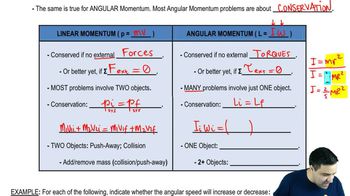
Conservation of Angular Momentum

Tangential Velocity

Tangential velocity refers to the linear speed of a point on the circumference of a rotating object. It is calculated as the product of the angular velocity (ω) and the radius (R) of the wheel, expressed as v = ωR. As the Ferris wheel accelerates, the tangential velocity increases, allowing us to determine the speed of a rider after the wheel has rotated through a specified angle.
Recommended video:
Guided course
05:53
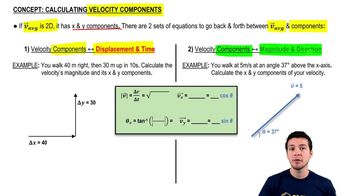
Calculating Velocity Components

Centripetal Acceleration

Centripetal acceleration is the acceleration directed towards the center of a circular path, necessary for an object to maintain circular motion. It is given by the formula a_c = v²/R, where v is the tangential velocity and R is the radius of the circular path. For a rider on the Ferris wheel, this acceleration ensures that they remain in circular motion as the wheel rotates.
Recommended video:
Guided course
06:48
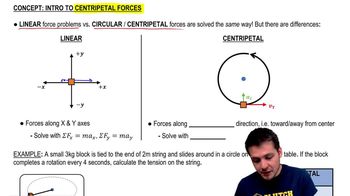
Intro to Centripetal Forces
Related Practice
Textbook Question

A ball rolling on a circular track, starting from rest, has angular acceleration α\alpha. Find an expression, in terms of α\alpha, for the time at which the ball's acceleration vector a is 4545^{\circ} away from a radial line toward the center of the circle.

812
views
Textbook Question

A typical laboratory centrifuge rotates at 4000 rpm. Test tubes have to be placed into a centrifuge very carefully because of the very large accelerations. What is the acceleration at the end of a test tube that is 10 cm from the axis of rotation?

1099
views
1
rank
Textbook Question

A typical laboratory centrifuge rotates at 4000 rpm. Test tubes have to be placed into a centrifuge very carefully because of the very large accelerations. For comparison, what is the magnitude of the acceleration a test tube would experience if dropped from a height of 1.0 m and stopped in a 1.0-ms-long encounter with a hard floor?

623
views
Textbook Question

Communications satellites are placed in a circular orbit where they stay directly over a fixed point on the equator as the earth rotates. These are called geosynchronous orbits. The radius of the earth is 6.37 x 10⁶ m, and the altitude of a geosynchronous orbit is 3.58 x 10⁷ m (≈ 22,000 miles). What are (a) the speed and (b) the magnitude of the acceleration of a satellite in a geosynchronous orbit?

2200
views
Textbook Question

A computer hard disk 8.0 cm in diameter is initially at rest. A small dot is painted on the edge of the disk. The disk accelerates at 600 rad/s² for ½ s, then coasts at a steady angular velocity for another ½ s. Through how many revolutions has the disk turned?

934
views
Textbook Question

Flywheels—rapidly rotating disks—are widely used in industry for storing energy. They are spun up slowly when extra energy is available, then decelerate quickly when needed to supply a boost of energy. A 20-cm-diameter rotor made of advanced materials can spin at 100,000 rpm. What is the speed of a point on the rim of this rotor?

751
views