
A computer hard disk 8.0 cm in diameter is initially at rest. A small dot is painted on the edge of the disk. The disk accelerates at 600 rad/s² for ½ s, then coasts at a steady angular velocity for another ½ s. Through how many revolutions has the disk turned?
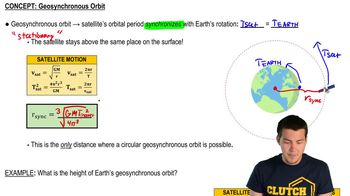
Communications satellites are placed in a circular orbit where they stay directly over a fixed point on the equator as the earth rotates. These are called geosynchronous orbits. The radius of the earth is 6.37 x 10⁶ m, and the altitude of a geosynchronous orbit is 3.58 x 10⁷ m (≈ 22,000 miles). What are (a) the speed and (b) the magnitude of the acceleration of a satellite in a geosynchronous orbit?
Verified step by step guidance
Verified video answer for a similar problem:
Key Concepts
Geosynchronous Orbit
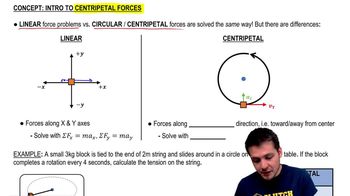
Centripetal Speed
Centripetal Acceleration
A Ferris wheel of radius R speeds up with angular acceleration starting from rest. Find expressions for the (a) velocity and (b) centripetal acceleration of a rider after the Ferris wheel has rotated through angle ∆θ.
A typical laboratory centrifuge rotates at 4000 rpm. Test tubes have to be placed into a centrifuge very carefully because of the very large accelerations. What is the acceleration at the end of a test tube that is 10 cm from the axis of rotation?
A typical laboratory centrifuge rotates at 4000 rpm. Test tubes have to be placed into a centrifuge very carefully because of the very large accelerations. For comparison, what is the magnitude of the acceleration a test tube would experience if dropped from a height of 1.0 m and stopped in a 1.0-ms-long encounter with a hard floor?
Flywheels—rapidly rotating disks—are widely used in industry for storing energy. They are spun up slowly when extra energy is available, then decelerate quickly when needed to supply a boost of energy. A 20-cm-diameter rotor made of advanced materials can spin at 100,000 rpm. What is the speed of a point on the rim of this rotor?
Flywheels—rapidly rotating disks—are widely used in industry for storing energy. They are spun up slowly when extra energy is available, then decelerate quickly when needed to supply a boost of energy. A 20-cm-diameter rotor made of advanced materials can spin at 100,000 rpm. b. Suppose the rotor's angular velocity decreases by 40% over 30 s as it supplies energy. What is the magnitude of the rotor's angular acceleration? Assume that the angular acceleration is constant.
