
Ch 04: Kinematics in Two Dimensions
Knight Calc - Physics for Scientists and Engineers 5th Edition
Knight Calc5th EditionPhysics for Scientists and EngineersISBN: 9780137344796Not the one you use?Change textbook
Chapter 4, Problem 24b

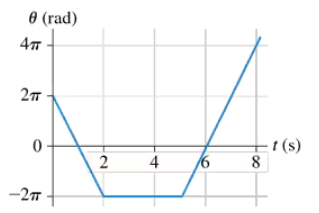
FIGURE EX4.24 shows the angular-position-versus-time graph for a particle moving in a circle. What is the particle's angular velocity at t = 4s

Verified step by step guidance
1
Step 1: Understand the concept of angular velocity. Angular velocity (ω) is defined as the rate of change of angular position (θ) with respect to time (t). Mathematically, ω = dθ/dt.
Step 2: Analyze the graph provided. The graph shows angular position (θ) versus time (t). At t = 4s, the graph is a straight line with a constant slope, indicating uniform angular velocity during this interval.
Step 3: Determine the slope of the graph in the interval from t = 0s to t = 5s. The slope of the graph represents the angular velocity. From the graph, θ changes from 0 to 2π radians over a time interval of 5 seconds.
Step 4: Calculate the angular velocity using the formula ω = Δθ/Δt. Here, Δθ = 2π radians and Δt = 5 seconds. Substitute these values into the formula.
Step 5: The angular velocity at t = 4s is equal to the slope calculated in Step 4, as the particle is moving with uniform angular velocity during this interval.

Verified video answer for a similar problem:

This video solution was recommended by our tutors as helpful for the problem above.
Video duration:
2m
Was this helpful?

Key Concepts

Here are the essential concepts you must grasp in order to answer the question correctly.

Angular Position

Angular position refers to the angle at which an object is located in a circular path, measured in radians. In the context of the graph, it shows how the angle changes over time as the particle moves in a circle. The vertical axis represents angular position, indicating the particle's orientation at any given moment.
Recommended video:
Guided course
14:03
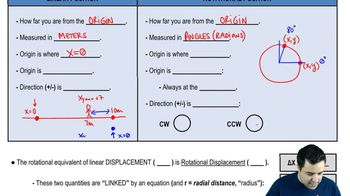
Rotational Position & Displacement

Angular Velocity

Angular velocity is the rate of change of angular position with respect to time, typically expressed in radians per second. It can be calculated by determining the slope of the angular position versus time graph. At t = 4s, the angular velocity can be found by analyzing the graph's slope during that interval.
Recommended video:
Guided course
06:18
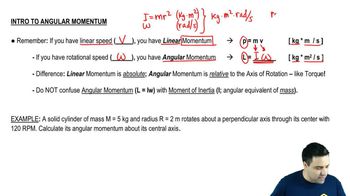
Intro to Angular Momentum

Graph Interpretation

Interpreting graphs is crucial in physics for understanding the relationship between different variables. In this case, the angular position versus time graph allows us to visualize how the particle's position changes over time, helping to identify periods of constant motion and changes in velocity. The flat sections indicate constant angular velocity, while the slopes indicate acceleration or deceleration.
Recommended video:
Guided course
07:32
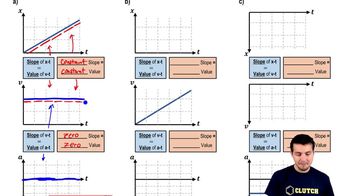
Graphing Position, Velocity, and Acceleration Graphs