Ch 05: Force and Motion
Knight Calc - Physics for Scientists and Engineers 5th Edition
Knight Calc5th EditionPhysics for Scientists and EngineersISBN: 9780137344796Not the one you use?Change textbook
Chapter 5, Problem 34d

A constant force is applied to an object, causing the object to accelerate at 10 m/s². What will the acceleration be if The force is halved and the object's mass is doubled?

Verified step by step guidance
1
Step 1: Recall Newton's Second Law of Motion, which states that the force acting on an object is equal to the product of its mass and acceleration: F = ma. Rearrange this equation to solve for acceleration: a = F/m.
Step 2: Identify the initial conditions. The object initially accelerates at 10 m/s² under a constant force. Using the formula for acceleration, the initial acceleration is given by a = F/m, where F is the force and m is the mass.
Step 3: Analyze the new conditions. The force is halved, so the new force becomes F/2. The mass is doubled, so the new mass becomes 2m.
Step 4: Substitute the new force and mass into the formula for acceleration: a = (F/2)/(2m). Simplify the expression: a = F/(4m).
Step 5: Compare the new acceleration to the initial acceleration. Since the initial acceleration was a = F/m, the new acceleration is one-fourth of the initial acceleration. Therefore, the new acceleration will be 10/4 m/s².

Verified video answer for a similar problem:

This video solution was recommended by our tutors as helpful for the problem above.
Video duration:
6m
Was this helpful?

Key Concepts

Here are the essential concepts you must grasp in order to answer the question correctly.

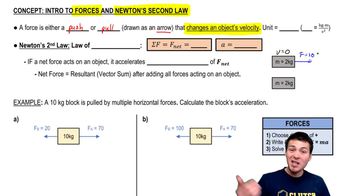
Newton's Second Law of Motion

Newton's Second Law states that the acceleration of an object is directly proportional to the net force acting on it and inversely proportional to its mass. This relationship is expressed by the formula F = ma, where F is the force, m is the mass, and a is the acceleration. Understanding this law is crucial for analyzing how changes in force and mass affect an object's acceleration.
Recommended video:
Guided course
06:54
Intro to Forces & Newton's Second Law

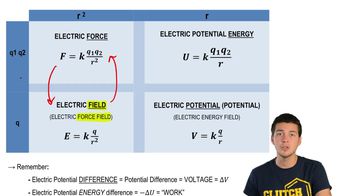
Force and Mass Relationship

The relationship between force, mass, and acceleration indicates that if the force applied to an object is reduced while its mass is increased, the resulting acceleration will change. Specifically, halving the force while doubling the mass leads to a new acceleration that can be calculated using the rearranged formula a = F/m. This concept is essential for predicting the object's behavior under varying conditions.
Recommended video:
Guided course
03:43
Relationships Between Force, Field, Energy, Potential

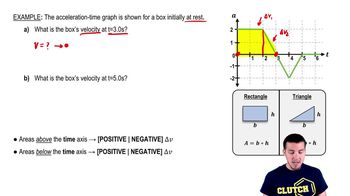
Acceleration Calculation

Acceleration is defined as the rate of change of velocity of an object over time. In this scenario, to find the new acceleration after modifying the force and mass, one can substitute the new values into the formula a = F/m. This calculation allows for a clear understanding of how the object's motion will be affected by the changes in force and mass.
Recommended video:
Guided course
05:33
Calculating Change in Velocity from Acceleration-Time Graphs