
Ch 05: Force and Motion
Chapter 5, Problem 14

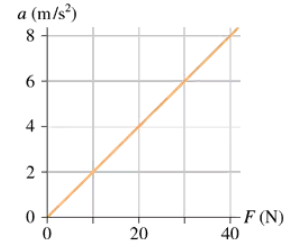
FIGURE EX5.14 shows an object's acceleration-versus-force graph. What is the object's mass?

Verified step by step guidance
1
Step 1: Recall Newton's Second Law of Motion, which states that \( F = ma \), where \( F \) is the force applied to an object, \( m \) is the object's mass, and \( a \) is the acceleration produced.
Step 2: From the graph, observe that the relationship between force \( F \) and acceleration \( a \) is linear. This indicates that the object's mass \( m \) is constant.
Step 3: To find the mass, calculate the slope of the graph. The slope of the graph is given by \( \text{slope} = \frac{\Delta a}{\Delta F} \), where \( \Delta a \) is the change in acceleration and \( \Delta F \) is the change in force.
Step 4: From the graph, select two points to determine \( \Delta a \) and \( \Delta F \). For example, at \( F = 0 \), \( a = 0 \), and at \( F = 150 \ \text{N} \), \( a = 3 \ \text{m/s}^2 \). Thus, \( \Delta a = 3 \ \text{m/s}^2 \) and \( \Delta F = 150 \ \text{N} \).
Step 5: Substitute the values into the slope formula: \( \text{slope} = \frac{\Delta a}{\Delta F} = \frac{3}{150} \). Since \( \text{slope} = \frac{1}{m} \), rearrange to find \( m = \frac{1}{\text{slope}} \).

Verified video answer for a similar problem:

This video solution was recommended by our tutors as helpful for the problem above.
Video duration:
3m
Was this helpful?

Key Concepts

Here are the essential concepts you must grasp in order to answer the question correctly.

Newton's Second Law of Motion

Newton's Second Law states that the acceleration of an object is directly proportional to the net force acting on it and inversely proportional to its mass. This relationship is expressed mathematically as F = ma, where F is the net force, m is the mass, and a is the acceleration. Understanding this law is crucial for analyzing the relationship between force, mass, and acceleration in the given graph.
Recommended video:
Guided course
06:54
Intro to Forces & Newton's Second Law

Force-Acceleration Graph

A force-acceleration graph plots acceleration on the y-axis against force on the x-axis. The slope of the line in such a graph represents the mass of the object, as per the rearranged form of Newton's Second Law (a = F/m). In this case, the linear relationship indicates that as force increases, acceleration increases proportionally, allowing for the calculation of mass from the slope.
Recommended video:
Guided course
07:32
Graphing Position, Velocity, and Acceleration Graphs

Slope of a Line

The slope of a line in a graph represents the rate of change of one variable with respect to another. In the context of the force-acceleration graph, the slope (rise over run) indicates how much acceleration changes for a given change in force. This slope is equal to 1/mass, allowing us to determine the mass of the object by calculating the slope of the line in the graph.
Recommended video:
Guided course
01:29
Slopes of Lines