
So-called volcanic 'ash' is actually finely pulverized rock blown high into the atmosphere. A typical ash particle is a 50--diameter piece of silica with a density of 2400 kg/m3. How long in hours does it take this ash particle to fall from a height of 5.0 km in still air? Use the properties of 20°C air at sea level.
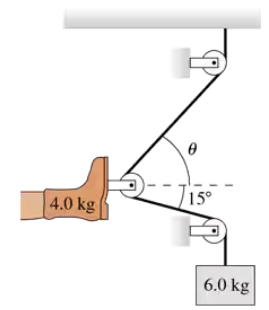
An accident victim with a broken leg is being placed in traction. The patient wears a special boot with a pulley attached to the sole. The foot and boot together have a mass of 4.0 kg, and the doctor has decided to hang a 6.0 kg mass from the rope. The boot is held suspended by the ropes, as shown in FIGURE P6.40, and does not touch the bed. Determine the amount of tension in the rope by using Newton's laws to analyze the hanging mass. Hint: If the pulleys are frictionless, which we will assume, the tension in the rope is constant from one end to the other.

Verified step by step guidance
Verified video answer for a similar problem:
Key Concepts
Newton's Laws of Motion
Tension in a Rope
Equilibrium of Forces
An E. coli bacterium can be modeled as a 0.50 μm diameter sphere that has the density of water. Rotating flagella propel a bacterium through 40°C water with a force of 65 fN, where 1 fN = 1femtonewton = 10-15 N. What is the bacterium's speed in μm/s?
A 2.0 kg object initially at rest at the origin is subjected to the time-varying force shown in FIGURE P6.38. What is the object's velocity at t = 4 s?
Seat belts and air bags save lives by reducing the forces exerted on the driver and passengers in an automobile collision. Cars are designed with a 'crumple zone' in the front of the car. In the event of an impact, the passenger compartment decelerates over a distance of about 1 m as the front of the car crumples. An occupant restrained by seat belts and air bags decelerates with the car. By contrast, an unrestrained occupant keeps moving forward with no loss of speed (Newton's first law!) until hitting the dashboard or windshield. These are unyielding surfaces, and the unfortunate occupant then decelerates over a distance of only about 5 mm. A 60 kg person is in a head-on collision. The car's speed at impact is 15 m/s. Estimate the net force on the person if he or she is wearing a seat belt and if the air bag deploys.
Compressed air is used to fire a 50 g ball vertically upward from a 1.0-m-tall tube. The air exerts an upward force of 2.0 N on the ball as long as it is in the tube. How high does the ball go above the top of the tube? Neglect air resistance.
A rifle with a barrel length of 60 cm fires a 10 g bullet with a horizontal speed of 400 m/s. The bullet strikes a block of wood and penetrates to a depth of 12 cm. How long does it take the bullet to come to rest?
