
Ch 06: Dynamics I: Motion Along a Line
Knight Calc - Physics for Scientists and Engineers 5th Edition
Knight Calc5th EditionPhysics for Scientists and EngineersISBN: 9780137344796Not the one you use?Change textbook
Chapter 6, Problem 38

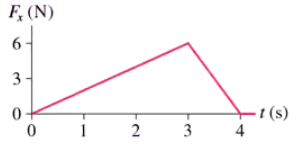
A 2.0 kg object initially at rest at the origin is subjected to the time-varying force shown in FIGURE P6.38. What is the object's velocity at t = 4 s?

Verified step by step guidance
1
Step 1: Understand the problem. The object starts at rest, meaning its initial velocity is zero. The force applied to the object varies with time, as shown in the graph. To find the velocity at t = 4 s, we need to calculate the impulse delivered to the object up to t = 4 s and use the impulse-momentum theorem.
Step 2: Recall the impulse-momentum theorem, which states that the impulse (J) is equal to the change in momentum (Δp). The impulse is given by the integral of the force over time: J = t F d t . Since the object starts at rest, its initial momentum is zero, and the final momentum is equal to the impulse.
Step 3: Break the graph into segments to calculate the impulse. From t = 0 to t = 2 s, the force increases linearly from 0 N to 4 N. The impulse for this segment can be calculated as the area of the triangle under the curve: J = 1 2 × base × height .
Step 4: From t = 2 s to t = 4 s, the force remains constant at 4 N. The impulse for this segment is the area of the rectangle under the curve: J = force × time . Add this impulse to the previous segment's impulse.
Step 5: Use the total impulse to find the velocity. The momentum is given by p = m × v , where m is the mass of the object. Rearrange to solve for velocity: v = J m . Substitute the total impulse and the mass (2.0 kg) to find the velocity at t = 4 s.

Verified video answer for a similar problem:

This video solution was recommended by our tutors as helpful for the problem above.
Video duration:
9m
Was this helpful?

Key Concepts

Here are the essential concepts you must grasp in order to answer the question correctly.

Newton's Second Law of Motion

Newton's Second Law states that the acceleration of an object is directly proportional to the net force acting on it and inversely proportional to its mass. This relationship is expressed mathematically as F = ma, where F is the net force, m is the mass, and a is the acceleration. Understanding this law is crucial for analyzing how the force applied to the object affects its motion.
Recommended video:
Guided course
06:54
Intro to Forces & Newton's Second Law

Impulse and Momentum

Impulse is defined as the change in momentum of an object when a force is applied over a period of time. It is calculated as the product of the average force and the time duration over which it acts. The relationship between impulse and momentum is given by the equation Impulse = Δp = F_avg * Δt, where Δp is the change in momentum. This concept is essential for determining the object's velocity after the force has been applied.
Recommended video:
Guided course
06:00
Impulse & Impulse-Momentum Theorem

Area Under the Force-Time Graph

The area under a force-time graph represents the impulse delivered to an object. In this case, the graph shows a time-varying force applied to the object, and calculating the area under the curve from t = 0 to t = 4 seconds will provide the total impulse. This impulse can then be used to find the change in momentum and, consequently, the final velocity of the object.
Recommended video:
Guided course
04:05
Calculating Work As Area Under F-x Graphs
Related Practice
Textbook Question

An accident victim with a broken leg is being placed in traction. The patient wears a special boot with a pulley attached to the sole. The foot and boot together have a mass of 4.0 kg, and the doctor has decided to hang a 6.0 kg mass from the rope. The boot is held suspended by the ropes, as shown in FIGURE P6.40, and does not touch the bed. Determine the amount of tension in the rope by using Newton's laws to analyze the hanging mass. Hint: If the pulleys are frictionless, which we will assume, the tension in the rope is constant from one end to the other.

2261
views
Textbook Question

Compressed air is used to fire a 50 g ball vertically upward from a 1.0-m-tall tube. The air exerts an upward force of 2.0 N on the ball as long as it is in the tube. How high does the ball go above the top of the tube? Neglect air resistance.

1862
views
Textbook Question

So-called volcanic 'ash' is actually finely pulverized rock blown high into the atmosphere. A typical ash particle is a 50-μm\(\mu\) m-diameter piece of silica with a density of 2400 kg/m3. How long in hours does it take this ash particle to fall from a height of 5.0 km in still air? Use the properties of 20°C air at sea level.

2240
views
1
comments
Textbook Question

An E. coli bacterium can be modeled as a 0.50 μm diameter sphere that has the density of water. Rotating flagella propel a bacterium through 40°C water with a force of 65 fN, where 1 fN = 1femtonewton = 10-15 N. What is the bacterium's speed in μm/s?

1334
views
Textbook Question

Seat belts and air bags save lives by reducing the forces exerted on the driver and passengers in an automobile collision. Cars are designed with a 'crumple zone' in the front of the car. In the event of an impact, the passenger compartment decelerates over a distance of about 1 m as the front of the car crumples. An occupant restrained by seat belts and air bags decelerates with the car. By contrast, an unrestrained occupant keeps moving forward with no loss of speed (Newton's first law!) until hitting the dashboard or windshield. These are unyielding surfaces, and the unfortunate occupant then decelerates over a distance of only about 5 mm. A 60 kg person is in a head-on collision. The car's speed at impact is 15 m/s. Estimate the net force on the person if he or she is wearing a seat belt and if the air bag deploys.

360
views
Textbook Question

So-called volcanic 'ash' is actually finely pulverized rock blown high into the atmosphere. A typical ash particle is a 50-μm-diameter piece of silica with a density of 2400 kg/m3. How long would it take this ash particle to fall from a height of 5.0 km in vacuum?

1231
views