Pearson+ LogoPearson+ Logo
Ch 06: Dynamics I: Motion Along a Line
Knight Calc - Physics for Scientists and Engineers 5th Edition
Knight Calc5th EditionPhysics for Scientists and EngineersISBN: 9780137344796Not the one you use?Change textbook
Chapter 6, Problem 59

Astronauts in space 'weigh' themselves by oscillating on a spring. Suppose the position of an oscillating 75 kg astronaut is given by x=(0.30m)sin((πrad/s)×t)x = (0.30 \, \text{m}) \sin((\pi \, \text{rad/s}) \times t), where t is in s. What force does the spring exert on the astronaut at (a) t = 1.0 s and (b) 1.5 s? Note that the angle of the sine function is in radians.

Verified step by step guidance
1
Step 1: Understand the problem. The astronaut is oscillating on a spring, and the position of the oscillation is given by the equation x = (0.30 m) sin((𝝅 rad/s) × t). The goal is to find the force exerted by the spring at specific times t = 1.0 s and t = 1.5 s. Recall that the force exerted by a spring is given by Hooke's Law: F = -kx, where k is the spring constant and x is the displacement.
Step 2: Determine the velocity and acceleration of the astronaut. The position function x(t) is given, so differentiate it with respect to time to find the velocity v(t) and acceleration a(t). The acceleration is needed because the force exerted by the spring is related to the acceleration of the astronaut. Use the formula: a(t) = d²x/dt². For x = (0.30 m) sin((𝝅 rad/s) × t), differentiate twice to get a(t).
Step 3: Calculate the acceleration at the given times. Substitute t = 1.0 s and t = 1.5 s into the acceleration function a(t) to find the acceleration values at these specific times. Ensure that the angle in the sine function is in radians, as specified in the problem.
Step 4: Relate the acceleration to the force. Use Newton's Second Law, F = ma, where m is the mass of the astronaut (75 kg) and a is the acceleration calculated in the previous step. This will give the force exerted by the spring at the specified times.
Step 5: Interpret the direction of the force. Since the spring force is restorative, it acts in the opposite direction of the displacement. Ensure that the sign of the force reflects this, as indicated by Hooke's Law (F = -kx).

Verified video answer for a similar problem:

This video solution was recommended by our tutors as helpful for the problem above.
Video duration:
6m
Was this helpful?

Key Concepts

Here are the essential concepts you must grasp in order to answer the question correctly.

Simple Harmonic Motion

Simple Harmonic Motion (SHM) describes the oscillatory motion of an object where the restoring force is directly proportional to the displacement from its equilibrium position. In this case, the astronaut oscillates on a spring, and the position function x = (0.30 m) sin((π rad/s) t) indicates that the motion is periodic, with a specific amplitude and angular frequency.
Recommended video:
Guided course
07:52
Simple Harmonic Motion of Pendulums

Hooke's Law

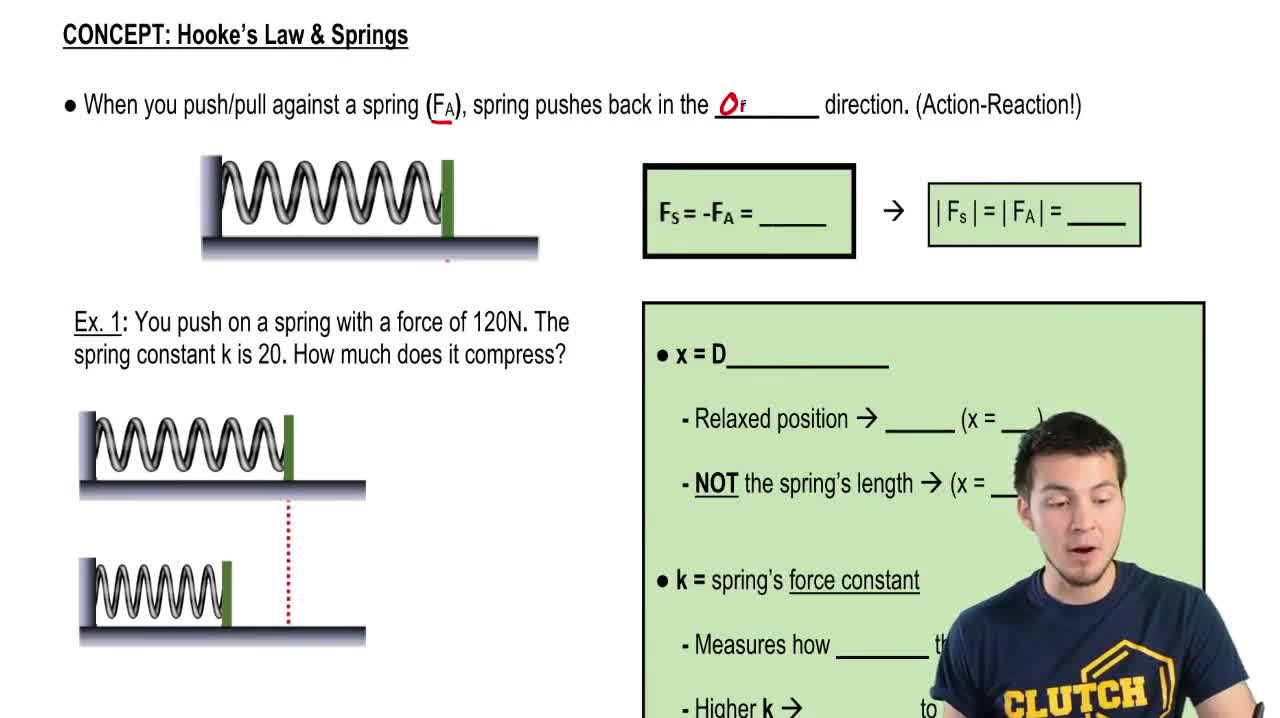
Hooke's Law states that the force exerted by a spring is proportional to the displacement from its equilibrium position, mathematically expressed as F = -kx, where k is the spring constant and x is the displacement. This principle is crucial for determining the force exerted by the spring on the astronaut at any given position during oscillation.
Recommended video:
Guided course
05:27
Spring Force (Hooke's Law)

Force Calculation in Oscillatory Motion

To find the force exerted by the spring on the astronaut at specific times, we first calculate the displacement x at those times using the given position function. Then, we apply Hooke's Law to determine the force, taking into account the mass of the astronaut and the acceleration due to gravity, which influences the net force experienced during oscillation.
Recommended video:
Guided course
05:29
Solving Motion Problems with Forces