Ch 09: Work and Kinetic Energy
Chapter 9, Problem 43b

A 1000 kg elevator accelerates upward at 1.0 m/s² for 10 m, starting from rest. How much work does the tension in the elevator cable do on the elevator?

Verified step by step guidance
1
Step 1: Identify the forces acting on the elevator. The tension in the cable (T) is responsible for lifting the elevator upward, while the gravitational force (mg) acts downward. The net force (F_net) is responsible for the upward acceleration.
Step 2: Use Newton's second law to calculate the tension in the cable. The net force is given by \( F_{\text{net}} = ma \), where \( m \) is the mass of the elevator and \( a \) is the acceleration. The tension in the cable can be expressed as \( T = F_{\text{net}} + mg \). Substitute \( m = 1000 \ \text{kg} \), \( a = 1.0 \ \text{m/s}^2 \), and \( g = 9.8 \ \text{m/s}^2 \) into the equation.
Step 3: Calculate the work done by the tension force. Work is defined as \( W = F \cdot d \cdot \cos \theta \), where \( F \) is the force, \( d \) is the displacement, and \( \theta \) is the angle between the force and displacement vectors. Since the tension force and displacement are both upward, \( \cos \theta = 1 \). Substitute \( T \) from Step 2 and \( d = 10 \ \text{m} \) into the equation.
Step 4: Simplify the work equation. Combine the values for \( T \) and \( d \) to express the work done by the tension force. Ensure the units are consistent throughout the calculation.
Step 5: Interpret the result. The work done by the tension force represents the energy transferred to the elevator to overcome gravity and provide upward acceleration over the 10 m displacement.

Verified video answer for a similar problem:

This video solution was recommended by our tutors as helpful for the problem above.
Video duration:
4m
Was this helpful?

Key Concepts

Here are the essential concepts you must grasp in order to answer the question correctly.

Newton's Second Law of Motion

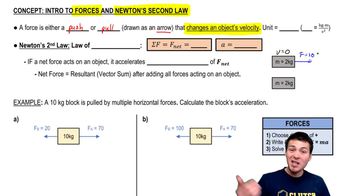
Newton's Second Law states that the force acting on an object is equal to the mass of that object multiplied by its acceleration (F = ma). In this scenario, the elevator's upward acceleration requires a net force that must overcome both the gravitational force acting downward and provide the necessary upward force for acceleration.
Recommended video:
Guided course
06:54
Intro to Forces & Newton's Second Law

Work-Energy Principle

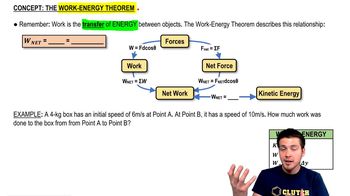
The Work-Energy Principle states that the work done on an object is equal to the change in its kinetic energy. In the case of the elevator, the work done by the tension in the cable must account for both the work against gravity and the work that contributes to the elevator's upward acceleration, affecting its kinetic energy.
Recommended video:
Guided course
04:10
The Work-Energy Theorem

Gravitational Force

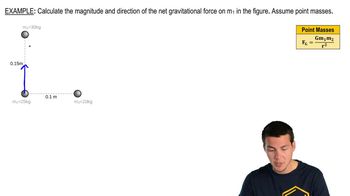
Gravitational force is the force exerted by the Earth on an object, calculated as the product of the object's mass and the acceleration due to gravity (approximately 9.81 m/s²). For the elevator, this force acts downward and must be considered when calculating the total tension in the cable, as it influences the net force required for the upward acceleration.
Recommended video:
Guided course
05:41
Gravitational Forces in 2D
Related Practice
Textbook Question

How much work does an elevator motor do to lift a 1000 kg elevator a height of 100 m? How much power must the motor supply to do this in 50 s at constant speed?

1041
views
Textbook Question

A 70 kg human sprinter can accelerate from rest to 10 m/s in 3.0 s. During the same time interval, a 30 kg greyhound can go from rest to 20 m/s. What is the average power output of each? Average power over a time interval ∆t is ∆E/∆t.

1234
views
Textbook Question

The energy used to pump liquids and gases through pipes is a significant fraction of the total energy consumption in the United States. Consider a small volume V of a liquid that has density ρ. Assume that the fluid is nonviscous so that friction with the pipe walls can be neglected. An upward-pushing force from a pump lifts this volume of fluid a height h at constant speed. How much work does the pump do?

1344
views
Textbook Question

Doug uses a 25 N horizontal force to push a 5.0 kg crate up a 2.0-m-high, 20° frictionless slope. What is the speed of the crate at the top of the slope?

873
views
3
rank
Textbook Question

A 150 g particle at x = 0 is moving at 2.00 m/s in the + x - direction. As it moves, it experiences a force given by Fₓ = (0.250 N) sin (x/2.00 m). What is the particle's speed when it reaches x = 3.14 m?

1687
views
Textbook Question

Susan's 10 kg baby brother Paul sits on a mat. Susan pulls the mat across the floor using a rope that is angled 30° above the floor. The tension is a constant 30 N and the coefficient of friction is 0.20. Use work and energy to find Paul's speed after being pulled 3.0 m.

1229
views
1
comments