
Textbook Question
FIGURE EX9.20 is the force-versus-position graph for a particle moving along the x-axis. Determine the work done on the particle during each of the three intervals 0–1 m, 1–2 m, and 2–3 m.
2391
views

 Verified step by step guidance
 06:09
06:09
 11:43
11:43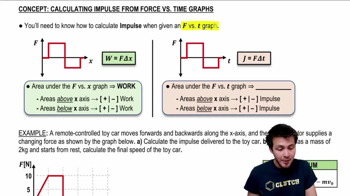 05:28
05:28FIGURE EX9.20 is the force-versus-position graph for a particle moving along the x-axis. Determine the work done on the particle during each of the three intervals 0–1 m, 1–2 m, and 2–3 m.
A horizontal spring with spring constant 750 N/m is attached to a wall. An athlete presses against the free end of the spring, compressing it 5.0 cm. How hard is the athlete pushing?
The three ropes shown in the bird's-eye view of FIGURE EX9.18 are used to drag a crate 3.0 m across the floor. How much work is done by each of the three forces?
A 35-cm-long vertical spring has one end fixed on the floor. Placing a 2.2 kg physics textbook on the spring compresses it to a length of 29 cm. What is the spring constant?
A 10-cm-long spring is attached to the ceiling. When a 2.0 kg mass is hung from it, the spring stretches to a length of 15 cm. How long is the spring when a 3.0 kg mass is suspended from it?
A 2.0 kg particle moving along the x-axis experiences the force shown in FIGURE EX9.22. The particle's velocity is 3.0 m/s at x = 0 m. At what point on the x-axis does the particle have a turning point?