Ch 09: Work and Kinetic Energy
Knight Calc - Physics for Scientists and Engineers 5th Edition
Knight Calc5th EditionPhysics for Scientists and EngineersISBN: 9780137344796Not the one you use?Change textbook
Chapter 9, Problem 22

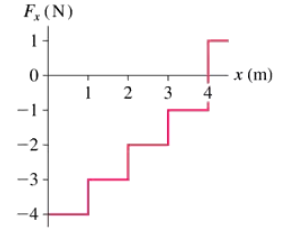
A 2.0 kg particle moving along the x-axis experiences the force shown in FIGURE EX9.22. The particle's velocity is 3.0 m/s at x = 0 m. At what point on the x-axis does the particle have a turning point?

Verified step by step guidance
1
Step 1: Understand the concept of a turning point. A turning point occurs when the particle's velocity becomes zero. This happens when the particle's kinetic energy is completely converted into work done against the force acting on it.
Step 2: Use the work-energy principle. The work done by the force on the particle is equal to the change in its kinetic energy. The work done can be calculated as the area under the force vs. position graph.
Step 3: Calculate the initial kinetic energy of the particle. The formula for kinetic energy is \( KE = \frac{1}{2} m v^2 \), where \( m \) is the mass of the particle and \( v \) is its velocity. Substitute \( m = 2.0 \, \text{kg} \) and \( v = 3.0 \, \text{m/s} \).
Step 4: Integrate the force over the distance to find the work done. Divide the graph into sections based on the constant force values and calculate the area of each section (rectangles). Add these areas cumulatively until the total work equals the initial kinetic energy.
Step 5: Determine the position \( x \) where the total work equals the initial kinetic energy. This position corresponds to the turning point of the particle on the x-axis.

Verified video answer for a similar problem:

This video solution was recommended by our tutors as helpful for the problem above.
Video duration:
3m
Was this helpful?

Key Concepts

Here are the essential concepts you must grasp in order to answer the question correctly.

Force and Motion

Force is a vector quantity that causes an object to accelerate, change direction, or deform. In this context, the force acting on the particle varies with position, as shown in the graph. Understanding how force influences motion is crucial for determining the particle's behavior along the x-axis, particularly when identifying turning points where the particle's velocity changes direction.
Recommended video:
Guided course
05:29
Solving Motion Problems with Forces

Turning Point

A turning point occurs when an object changes its direction of motion. For a particle moving along the x-axis, this happens when the net force acting on it becomes zero, leading to a momentary stop before reversing direction. Analyzing the force graph allows us to identify the position where the force changes from positive to negative, indicating the location of the turning point.
Recommended video:
Guided course
08:35
Angular Momentum of a Point Mass

Work-Energy Principle

The work-energy principle states that the work done on an object is equal to the change in its kinetic energy. In this scenario, as the particle moves through different positions, the work done by the varying force affects its velocity. By calculating the work done up to a certain point, we can determine how the particle's kinetic energy changes, which is essential for finding the turning point.
Recommended video:
Guided course
04:10
The Work-Energy Theorem