
Ch 11: Impulse and Momentum
Chapter 11, Problem 43

A particle of mass m is at rest at t = 0. Its momentum for t > 0 is given by px = 6t² kg m/s, where t is in s. Find an expression for Fx(t), the force exerted on the particle as a function of time.

Verified step by step guidance
1
Step 1: Recall Newton's second law of motion, which states that the force acting on an object is equal to the rate of change of its momentum. Mathematically, this is expressed as F = d

/dt, where

is the momentum.

Step 2: Identify the given momentum function in the problem: px = 6t² kg·m/s. This represents the momentum of the particle as a function of time.
Step 3: Differentiate the momentum function px with respect to time t to find the force Fx(t). Using the derivative rule for polynomials, d(6t²)/dt = 12t.
Step 4: Write the expression for the force Fx(t) based on the differentiation result. Fx(t) = 12t N, where N (newtons) is the unit of force.
Step 5: Conclude that the force Fx(t) is directly proportional to time t, meaning the force increases linearly as time progresses.

Verified video answer for a similar problem:

This video solution was recommended by our tutors as helpful for the problem above.
Video duration:
2m
Was this helpful?

Key Concepts

Here are the essential concepts you must grasp in order to answer the question correctly.

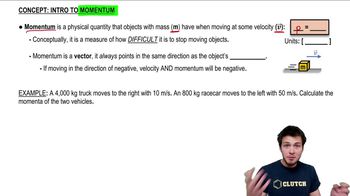
Momentum

Momentum is a vector quantity defined as the product of an object's mass and its velocity. In this case, the momentum of the particle is given as a function of time, which indicates how it changes as the particle accelerates. Understanding momentum is crucial for analyzing the motion of the particle and how forces affect it.
Recommended video:
Guided course
05:17
Intro to Momentum

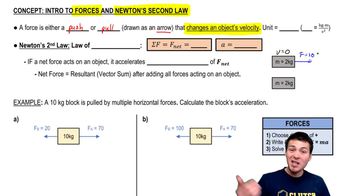
Newton's Second Law

Newton's Second Law states that the force acting on an object is equal to the rate of change of its momentum. Mathematically, this is expressed as F = dp/dt, where F is the force, p is momentum, and t is time. This principle allows us to relate the given momentum function to the force exerted on the particle.
Recommended video:
Guided course
06:54
Intro to Forces & Newton's Second Law

Calculus

Calculus is a branch of mathematics that deals with rates of change and accumulation. In this context, we will use differentiation to find the force as a function of time by calculating the derivative of the momentum function with respect to time. This process is essential for determining how the force varies as the particle moves.
Recommended video:
Guided course
04:53
Biot-Savart Law with Calculus
Related Practice
Textbook Question

A 550 g cart is released from rest on a frictionless, 30° ramp, 120 cm from the bottom of the ramp. It rolls down, bounces off a rubber block at the bottom, and then rolls 80 cm back up the ramp. A high-speed video shows that the cart was in contact with the rubber block for 25 ms. What was the average force exerted on the cart by the block?

1163
views
1
rank
Textbook Question

A tennis player swings her 1000g racket with a speed of 10 m/s. She hits a 60g tennis ball that was approaching her at a speed of 20 m/s. The ball rebounds at 40 m/s. If the tennis ball and racket are in contact for 10 ms, what is the average force that the racket exerts on the ball? How does this compare to the gravitational force on the ball?

887
views
Textbook Question

A 60 g tennis ball with an initial speed of 32 m/s hits a wall and rebounds with the same speed. FIGURE P11.40 shows the force of the wall on the ball during the collision. What is the value of Fmax , the maximum value of the contact force during the collision?

126
views
Textbook Question

Most geologists believe that the dinosaurs became extinct 65 million years ago when a large comet or asteroid struck the earth, throwing up so much dust that the sun was blocked out for a period of many months. Suppose an asteroid with a diameter of 2.0 km and a mass of 1.0×10¹³ kg hits the earth (6.0×10²⁴ kg) with an impact speed of 4.0×10⁴ m/s. What percentage is this of the earth's speed around the sun? The earth orbits the sun at a distance of 1.5×10¹¹ m .

918
views
Textbook Question

BIO Squids rely on jet propulsion to move around. A 1.50 kg squid (including the mass of water inside the squid) drifting at 0.40m/s suddenly ejects 0.100 kg of water to get itself moving at 2.50m/s . If drag is ignored over the small interval of time needed to expel the water (the impulse approximation), what is the water’s ejection speed relative to the squid?

656
views
Textbook Question

A bullet of mass m is fired into a block of mass M that is at rest. The block, with the bullet embedded, slides distance d across a horizontal surface. The coefficient of kinetic friction is μk .Find an expression for the bullet's speed vbullet.

1323
views