Pearson+ LogoPearson+ Logo
Ch 12: Rotation of a Rigid Body
Knight Calc - Physics for Scientists and Engineers 5th Edition
Knight Calc5th EditionPhysics for Scientists and EngineersISBN: 9780137344796Not the one you use?Change textbook
Chapter 12, Problem 25

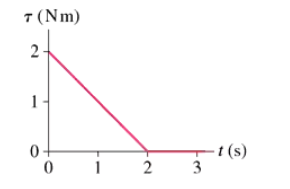
An object whose moment of inertia is 4.0 kg m2 is rotating with angular velocity 0.25 rad/s. It then experiences the torque shown in FIGURE EX12.25. What is the object's angular velocity at t = 3.0s?

Verified step by step guidance
1
Step 1: Identify the relationship between torque (τ), angular acceleration (α), and moment of inertia (I). The equation is τ = I * α. Rearrange to find angular acceleration: α = τ / I.
Step 2: Analyze the graph of torque versus time. The torque is 4 Nm from t = 0 to t = 1 s, decreases linearly to 0 Nm from t = 1 s to t = 2 s, and remains 0 Nm from t = 2 s to t = 3 s.
Step 3: Calculate angular acceleration for each time interval using α = τ / I. For t = 0 to t = 1 s, α = 4 Nm / 4.0 kg·m² = 1 rad/s². For t = 1 to t = 2 s, α decreases linearly as torque decreases. For t = 2 to t = 3 s, α = 0 rad/s² since torque is 0.
Step 4: Use the kinematic equation for angular velocity: ω_final = ω_initial + α * Δt. Apply this equation for each time interval sequentially, starting with ω_initial = 0.25 rad/s at t = 0.
Step 5: Integrate angular acceleration over time to find the change in angular velocity for the interval t = 1 to t = 2 s, where α varies linearly. Add this to the angular velocity calculated for the previous interval to find ω at t = 3 s.

Verified video answer for a similar problem:

This video solution was recommended by our tutors as helpful for the problem above.
Video duration:
7m
Was this helpful?

Key Concepts

Here are the essential concepts you must grasp in order to answer the question correctly.

Moment of Inertia

Moment of inertia is a measure of an object's resistance to changes in its rotational motion. It depends on the mass distribution relative to the axis of rotation. The greater the moment of inertia, the more torque is required to change the angular velocity of the object. In this case, the moment of inertia is given as 4.0 kg m².
Recommended video:
Guided course
11:47
Intro to Moment of Inertia

Torque

Torque is a measure of the rotational force applied to an object, causing it to rotate about an axis. It is calculated as the product of the force and the distance from the axis of rotation. The graph provided shows how torque varies with time, which is crucial for determining how the angular velocity of the object changes over time due to the applied torque.
Recommended video:
Guided course
08:55
Net Torque & Sign of Torque

Angular Velocity

Angular velocity is the rate of change of angular displacement and is measured in radians per second (rad/s). It indicates how fast an object is rotating around an axis. In this problem, the initial angular velocity is 0.25 rad/s, and the change in angular velocity over time will be influenced by the torque applied, as shown in the graph.
Recommended video:
Guided course
06:18
Intro to Angular Momentum