
Pearson+ LogoPearson+ Logo
Ch 13: Newton's Theory of Gravity
Knight Calc - Physics for Scientists and Engineers 5th Edition
Knight Calc5th EditionPhysics for Scientists and EngineersISBN: 9780137344796Not the one you use?Change textbook
Chapter 13, Problem 49

A starship is circling a distant planet of radius R. The astronauts find that the free-fall acceleration at their altitude is half the value at the planet's surface. How far above the surface are they orbiting? Your answer will be a multiple of R.

Verified step by step guidance
1
Step 1: Recall the formula for gravitational acceleration: \( g = \frac{GM}{r^2} \), where \( G \) is the gravitational constant, \( M \) is the mass of the planet, and \( r \) is the distance from the center of the planet.
Step 2: Let \( g_s \) represent the gravitational acceleration at the planet's surface. At the surface, \( r = R \), so \( g_s = \frac{GM}{R^2} \).
Step 3: At the altitude of the starship, the gravitational acceleration is given as half the surface value, \( g_{orbit} = \frac{g_s}{2} \). Substitute \( g_s \) into this equation: \( \frac{GM}{r^2} = \frac{1}{2} \cdot \frac{GM}{R^2} \).
Step 4: Simplify the equation to find the relationship between \( r \) and \( R \): \( \frac{1}{r^2} = \frac{1}{2} \cdot \frac{1}{R^2} \). Rearrange to solve for \( r \): \( r = \sqrt{2} \cdot R \).
Step 5: The altitude above the surface is the distance from the center minus the planet's radius: \( h = r - R \). Substitute \( r = \sqrt{2} \cdot R \) to find \( h = (\sqrt{2} - 1) \cdot R \).

Verified video answer for a similar problem:

This video solution was recommended by our tutors as helpful for the problem above.
Video duration:
4m
Was this helpful?

Key Concepts

Here are the essential concepts you must grasp in order to answer the question correctly.

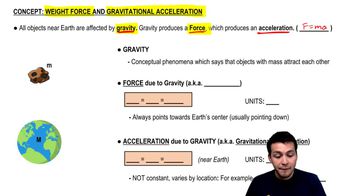
Gravitational Acceleration

Gravitational acceleration is the acceleration experienced by an object due to the gravitational force exerted by a massive body, such as a planet. At the surface of a planet, this acceleration is denoted as 'g'. As one moves away from the surface, gravitational acceleration decreases according to the inverse square law, which states that the force of gravity is inversely proportional to the square of the distance from the center of the mass.
Recommended video:
Guided course
07:32
Weight Force & Gravitational Acceleration

Orbital Mechanics

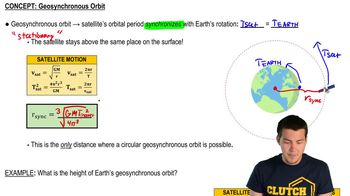
Orbital mechanics is the study of the motion of objects in space under the influence of gravitational forces. For a starship in orbit, the balance between gravitational pull and the ship's velocity creates a stable path around the planet. The altitude of the orbit affects the gravitational force experienced by the spacecraft, which is crucial for determining how far above the planet's surface the ship is located.
Recommended video:
Guided course
04:45
Geosynchronous Orbits

Height Above Surface

The height above the surface of a planet is the vertical distance from the planet's surface to the object in orbit. In this scenario, the astronauts experience a gravitational acceleration that is half of that at the surface, indicating they are at a specific altitude. This relationship can be expressed mathematically, allowing us to calculate the height in terms of the planet's radius, R, by applying the principles of gravitational acceleration and orbital dynamics.
Recommended video:
Guided course
09:18
Equipotential Surfaces
Related Practice
Textbook Question

Suppose that on earth you can jump straight up a distance of 45 cm. Asteroids are made of material with mass density 2800 kg/m³ . What is the maximum diameter of a spherical asteroid from which you could escape by jumping?

140
views
Textbook Question

A rogue band of colonists on the moon declares war and prepares to use a catapult to launch large boulders at the earth. Assume that the boulders are launched from the point on the moon nearest the earth. For this problem you can ignore the rotation of the two bodies and the orbiting of the moon. What is the minimum speed with which a boulder must be launched to reach the earth? Hint: The minimum speed is not the escape speed. You need to analyze a three-body system.

444
views
Textbook Question

The two stars in a binary star system have masses 2.0 x 10³⁰ kg and 6.0 x 10³⁰ kg. They are separated by 2.0 x 10¹² m. What are The speed of each star?

155
views
Textbook Question

A 4000 kg lunar lander is in orbit 50 km above the surface of the moon. It needs to move out to a 300-km-high orbit in order to link up with the mother ship that will take the astronauts home. How much work must the thrusters do?

357
views
Textbook Question

The 75,000 kg space shuttle used to fly in a 250-km-high circular orbit. It needed to reach a 610-km-high circular orbit to service the Hubble Space Telescope. How much energy was required to boost it to the new orbit?

584
views
Textbook Question

In 2000, NASA placed a satellite in orbit around an asteroid. Consider a spherical asteroid with a mass of 1.0 x 10¹⁶ kg and a radius of 8.8 km. What is the escape speed from the asteroid?

510
views