
The greenhouse-gas carbon dioxide molecule CO₂ strongly absorbs infrared radiation when its vibrational normal modes are excited by light at the normal-mode frequencies. CO₂ is a linear triatomic molecule, as shown in FIGURE CP15.82, with oxygen atoms of mass mo bonded to a central carbon atom of mass mc. You know from chemistry that the atomic masses of carbon and oxygen are, respectively, 12 and 16. Assume that the bond is an ideal spring with spring constant k. There are two normal modes of this system for which oscillations take place along the axis. (You can ignore additional bending modes.) In this problem, you will find the normal modes and then use experimental data to determine the bond spring constant. The symmetric stretch frequency is known to be 4.00 X 10¹³ Hz. What is the spring constant of the C - O bond? Use 1 u = 1 atomic mass unit = 1.66 X 10⁻²⁷ kg to find the atomic masses in SI units. Interestingly, the spring constant is similar to that of springs you might use in the lab.

- Ch 01: Concepts of Motion35
- Ch 02: Kinematics in One Dimension75
- Ch 03: Vectors and Coordinate Systems58
- Ch 04: Kinematics in Two Dimensions60
- Ch 05: Force and Motion23
- Ch 06: Dynamics I: Motion Along a Line53
- Ch 07: Newton's Third Law27
- Ch 08: Dynamics II: Motion in a Plane52
- Ch 09: Work and Kinetic Energy56
- Ch 10: Interactions and Potential Energy50
- Ch 11: Impulse and Momentum56
- Ch 12: Rotation of a Rigid Body71
- Ch 13: Newton's Theory of Gravity52
- Ch 14: Fluids and Elasticity44
- Ch 15: Oscillations55
- Ch 16: Traveling Waves37
- Ch 17: Superposition39
- Ch 18: A Macroscopic Description of Matter53
- Ch 19: Work, Heat, and the First Law of Thermodynamics60
- Ch 20: The Micro/Macro Connection53
- Ch 21: Heat Engines and Refrigerators34
- Ch 22: Electric Charges and Forces40
- Ch 23: The Electric Field39
- Ch 24: Gauss' Law32
- Ch 25: The Electric Potential63
- Ch 26: Potential and Field57
- Ch 27: Current and Resistance42
- Ch 28: Fundamentals of Circuits39
- Ch 29: The Magnetic Field47
- Ch 30: Electromagnetic Induction60
- Ch 31: Electromagnetic Fields and Waves32
- Ch 32: AC Circuits63
- Ch 33: Wave Optics32
- Ch 34: Ray Optics57
- Ch 35: Optical Instruments30
- Ch 36: Special Relativity38
- Ch 37: The Foundations of Modern Physics25
- Ch 38: Quantization49
- Ch 39: Wave Functions and Uncertainty31
- Ch 40: One-Dimensional Quantum Mechanics35
- Ch 41: Atomic Physics18
- Ch 42: Nuclear Physics27
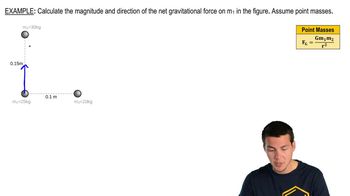
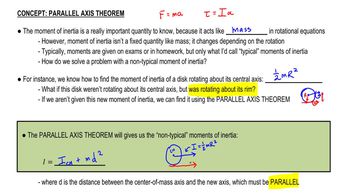
Suppose a large spherical object, such as a planet, with radius R and mass M has a narrow tunnel passing diametrically through it. A particle of mass m is inside the tunnel at a distance 𝓍 ≤ R from the center. It can be shown that the net gravitational force on the particle is due entirely to the sphere of mass with radius 𝓇 ≤ 𝓍 there is no net gravitational force from the mass in the spherical shell with 𝓇 > 𝓍. a. Find an expression for the gravitational force on the particle, assuming the object has uniform density. Your expression will be in terms of x, R, m, M, and any necessary constants.
 Verified step by step guidance
Verified video answer for a similar problem:

Key Concepts
Gravitational Force
 05:41
05:41
Shell Theorem
 13:46
13:46Uniform Density
 8:13
8:13The 15 g head of a bobble-head doll oscillates in SHM at a frequency of 4.0 Hz. The amplitude of the head's oscillations decreases to 0.5 cm in 4.0 s. What is the head's damping constant?
A spring is standing upright on a table with its bottom end fastened to the table. A block is dropped from a height 3.0 cm above the top of the spring. The block sticks to the top end of the spring and then oscillates with an amplitude of 10 cm. What is the oscillation frequency?
A uniform rod of length L oscillates as a pendulum about a pivot that is a distance x from the center. For what value of x, in terms of L, is the oscillation period a minimum?
A 200 g oscillator in a vacuum chamber has a frequency of 2.0 Hz. When air is admitted, the oscillation decreases to 60% of its initial amplitude in 50 s. How many oscillations will have been completed when the amplitude is 30% of its initial value?
A block on a frictionless table is connected as shown in FIGURE P15.75 to two springs having spring constants k₁ and k₂. Find an expression for the block’s oscillation frequency f in terms of the frequencies f₁ and f₂ at which it would oscillate if attached to spring 1 or spring 2 alone.