
Here are the essential concepts you must grasp in order to answer the question correctly.
Wave Speed on a String
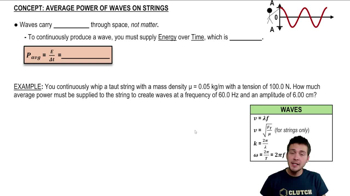
The speed of a wave on a string is determined by the tension in the string and its linear mass density. The relationship is given by the formula v = √(T/μ), where v is the wave speed, T is the tension, and μ is the linear mass density. This means that as tension increases, wave speed increases, and vice versa.
Recommended video:
Energy & Power of Waves on Strings
Tension in a String
Tension refers to the force exerted along the length of the string, which affects how quickly waves can travel through it. When tension is increased, the string becomes tighter, allowing waves to propagate faster. Conversely, reducing the tension decreases the wave speed, illustrating the direct relationship between tension and wave propagation.
Recommended video:
Energy & Power of Waves on Strings
Linear Mass Density
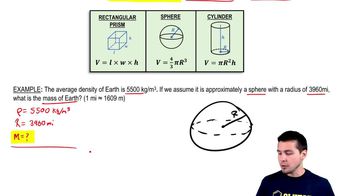
Linear mass density (μ) is defined as the mass per unit length of the string. It plays a crucial role in determining wave speed, as it affects how much mass the tension must move. While the problem does not change the linear mass density, understanding its role helps clarify why changes in tension directly influence wave speed.
Recommended video:
Problems with Mass, Volume, & Density