Ch 18: A Macroscopic Description of Matter
Chapter 18, Problem 65b

A container of gas at 2.0 atm pressure and 127°C is compressed at constant temperature until the volume is halved. It is then further compressed at constant pressure until the volume is halved again. Show this process on a pV diagram.

Verified step by step guidance
1
Step 1: Understand the problem. The gas undergoes two processes: (1) an isothermal compression where the volume is halved at constant temperature, and (2) an isobaric compression where the volume is halved again at constant pressure. We need to represent these processes on a pressure-volume (pV) diagram.
Step 2: Recall the relationship for an isothermal process. For an ideal gas undergoing an isothermal process, the pressure and volume are related by Boyle's Law: pV1 = p2V2. Since the volume is halved, the pressure will double during this step.
Step 3: Represent the isothermal process on the pV diagram. Start with the initial state (p = 2.0 atm, V = V₀). As the volume is halved (V = V₀/2), the pressure increases to 4.0 atm. Plot this curve as a hyperbolic line on the pV diagram, since pV = constant for an isothermal process.
Step 4: Recall the relationship for an isobaric process. For an isobaric process, the pressure remains constant while the volume changes. In this case, the volume is halved again (V = V₀/4), but the pressure remains at 4.0 atm.
Step 5: Represent the isobaric process on the pV diagram. From the endpoint of the isothermal process (p = 4.0 atm, V = V₀/2), draw a horizontal line to the new volume (V = V₀/4) while keeping the pressure constant at 4.0 atm. This completes the pV diagram for the described process.

Verified video answer for a similar problem:

This video solution was recommended by our tutors as helpful for the problem above.
Video duration:
9m
Was this helpful?

Key Concepts

Here are the essential concepts you must grasp in order to answer the question correctly.

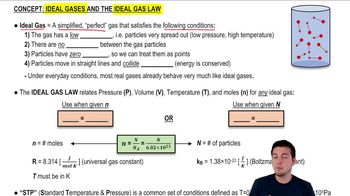
Ideal Gas Law

The Ideal Gas Law relates the pressure, volume, and temperature of an ideal gas through the equation PV = nRT. This law is fundamental in understanding how gases behave under varying conditions. In this scenario, it helps explain the relationship between pressure and volume during the compression processes described.
Recommended video:
Guided course
07:21
Ideal Gases and the Ideal Gas Law

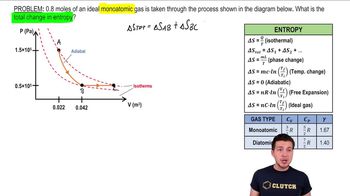
Isothermal Process

An isothermal process occurs when a gas is compressed or expanded at a constant temperature. During this process, the internal energy of the gas remains constant, and any work done on or by the gas results in heat exchange with the surroundings. This concept is crucial for the first part of the question, where the gas is compressed at constant temperature.
Recommended video:
Guided course
06:13
Entropy & Ideal Gas Processes

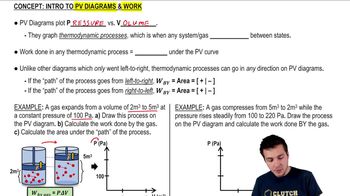
pV Diagram

A pV diagram is a graphical representation of the relationship between pressure (p) and volume (V) for a gas. It visually illustrates the changes in state of the gas during different processes, such as isothermal and isobaric. Understanding how to plot these processes on a pV diagram is essential for analyzing the behavior of the gas during the described compressions.
Recommended video:
Guided course
08:07
Work and PV Diagrams
Related Practice
Textbook Question

A diver 50 m deep in 10°C fresh water exhales a 1.0-cm-diameter bubble. What is the bubble's diameter just as it reaches the surface of the lake, where the water temperature is 20°C?

996
views
Textbook Question

In Problems 67,68,69,67, 68, 69, and 7070 you are given the equation(s) used to solve a problem. For each of these, you are to draw a pV diagram.

(T2+273) K=200 kPa500 kPa×1×(400+273) K(T_2 + 273) \text{ K} = \frac{200 \text{ kPa}}{500 \text{ kPa}} \times 1 \times (400 + 273) \text{ K}

587
views
Textbook Question

10 g of dry ice (solid CO₂) is placed in a 10,000 cm3 container, then all the air is quickly pumped out and the container sealed. The container is warmed to 0°C, a temperature at which CO₂ is a gas. What is the gas pressure? Give your answer in atm. The gas then undergoes an isothermal compression until the pressure is 3.0 atm, immediately followed by an isobaric compression until the volume is 1000 cm3.

922
views
Textbook Question

Five grams of nitrogen gas at an initial pressure of 3.0 atm and at 20°C undergo an isobaric expansion until the volume has tripled. What is the gas volume after the expansion?

631
views
Textbook Question

Five grams of nitrogen gas at an initial pressure of 3.0 atm and at 20°C undergo an isobaric expansion until the volume has tripled. What is the gas temperature after the expansion (in °C)? The gas pressure is then decreased at constant volume until the original temperature is reached.

619
views
Textbook Question

In Problems 67,68,69,67, 68, 69, and 7070 you are given the equation(s) used to solve a problem. For each of these, you are to write a realistic problem for which this is the correct equation(s).

p2=300 cm3100 cm3×1×2 atmp_2 = \frac{300 \text{ cm}^3}{100 \text{ cm}^3} \times 1 \times 2 \text{ atm}

883
views