A cylinder of nitrogen and a cylinder of neon are at the same temperature and pressure. The mean free path of a nitrogen molecule is 150 nm. What is the mean free path of a neon atom?
Verified step by step guidance
1
Understand the concept of mean free path: The mean free path (λ) is the average distance a particle travels between collisions. It is inversely proportional to the number density of particles (n) and the collision cross-section (σ). The formula is λ = 1 / (√2 * n * σ).
Recognize that the temperature and pressure are the same for both gases. This implies that the number density (n) of the gas molecules is the same for nitrogen and neon, as n = P / (k_B * T), where P is pressure, T is temperature, and k_B is Boltzmann's constant.
Note that the mean free path depends on the collision cross-section (σ), which is related to the size of the molecules or atoms. The collision cross-section is proportional to the square of the effective diameter of the particles: σ ∝ d².
Set up the ratio of the mean free paths for nitrogen (λ_N₂) and neon (λ_Ne). Since λ ∝ 1/σ, the ratio is λ_Ne / λ_N₂ = σ_N₂ / σ_Ne. Substituting σ ∝ d², we get λ_Ne / λ_N₂ = (d_N₂ / d_Ne)².
Use the given mean free path of nitrogen (λ_N₂ = 150 nm) and the known molecular diameters of nitrogen and neon to calculate the mean free path of neon. Rearrange the equation to solve for λ_Ne: λ_Ne = λ_N₂ * (d_N₂ / d_Ne)².
Verified video answer for a similar problem:
This video solution was recommended by our tutors as helpful for the problem above.
Video duration:
4m
Play a video:
0 Comments
Key Concepts
Here are the essential concepts you must grasp in order to answer the question correctly.
Mean Free Path
The mean free path is the average distance a particle travels between collisions with other particles. It is influenced by the size of the particles and the density of the gas. In gases, a longer mean free path indicates fewer collisions, while a shorter mean free path suggests more frequent interactions.
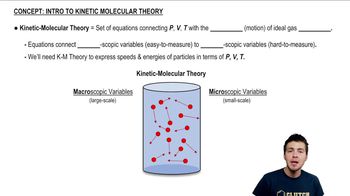
The kinetic theory of gases describes the behavior of gases in terms of particles in constant motion. It explains how temperature, pressure, and volume relate to the motion and collisions of gas molecules. This theory helps in understanding properties like mean free path by relating them to molecular speed and density.
The properties of gases, including mean free path, are affected by the size and mass of the gas molecules. Lighter and smaller molecules, like neon, generally have a different mean free path compared to heavier molecules, like nitrogen, even under the same conditions of temperature and pressure. This relationship is crucial for calculating the mean free path of different gases.



 08:20
08:20