
Pearson+ LogoPearson+ Logo
Ch 20: The Micro/Macro Connection
Knight Calc - Physics for Scientists and Engineers 5th Edition
Knight Calc5th EditionPhysics for Scientists and EngineersISBN: 9780137344796Not the one you use?Change textbook
Chapter 20, Problem 71

A thin partition divides a container of volume V into two parts. One side contains nA moles of gas A in a fraction fA of the container; that is, VA = fAV. The other side contains nB moles of a different gas B at the same temperature in a fraction fB of the container. The partition is removed, allowing the gases to mix. Find an expression for the change of entropy. This is called the entropy of mixing.

Verified step by step guidance
1
Start by recalling the formula for entropy change for an ideal gas when it expands or compresses: ΔS = nRln(Vf/Vi), where n is the number of moles, R is the gas constant, Vf is the final volume, and Vi is the initial volume.
For gas A, initially it occupies a volume VA = fA * V. After the partition is removed, it expands to occupy the entire container volume V. The change in entropy for gas A is ΔSA = nA * R * ln(V/VA). Substitute VA = fA * V into the equation to get ΔSA = nA * R * ln(1/fA).
Similarly, for gas B, initially it occupies a volume VB = fB * V. After the partition is removed, it also expands to occupy the entire container volume V. The change in entropy for gas B is ΔSB = nB * R * ln(V/VB). Substitute VB = fB * V into the equation to get ΔSB = nB * R * ln(1/fB).
The total change in entropy (ΔS_total) is the sum of the entropy changes for both gases: ΔS_total = ΔSA + ΔSB. Substitute the expressions for ΔSA and ΔSB to get ΔS_total = nA * R * ln(1/fA) + nB * R * ln(1/fB).
Simplify the expression for the total entropy change: ΔS_total = R * [nA * ln(1/fA) + nB * ln(1/fB)]. This is the final expression for the entropy of mixing.

Verified video answer for a similar problem:

This video solution was recommended by our tutors as helpful for the problem above.
Video duration:
10m
Was this helpful?

Key Concepts

Here are the essential concepts you must grasp in order to answer the question correctly.

Entropy

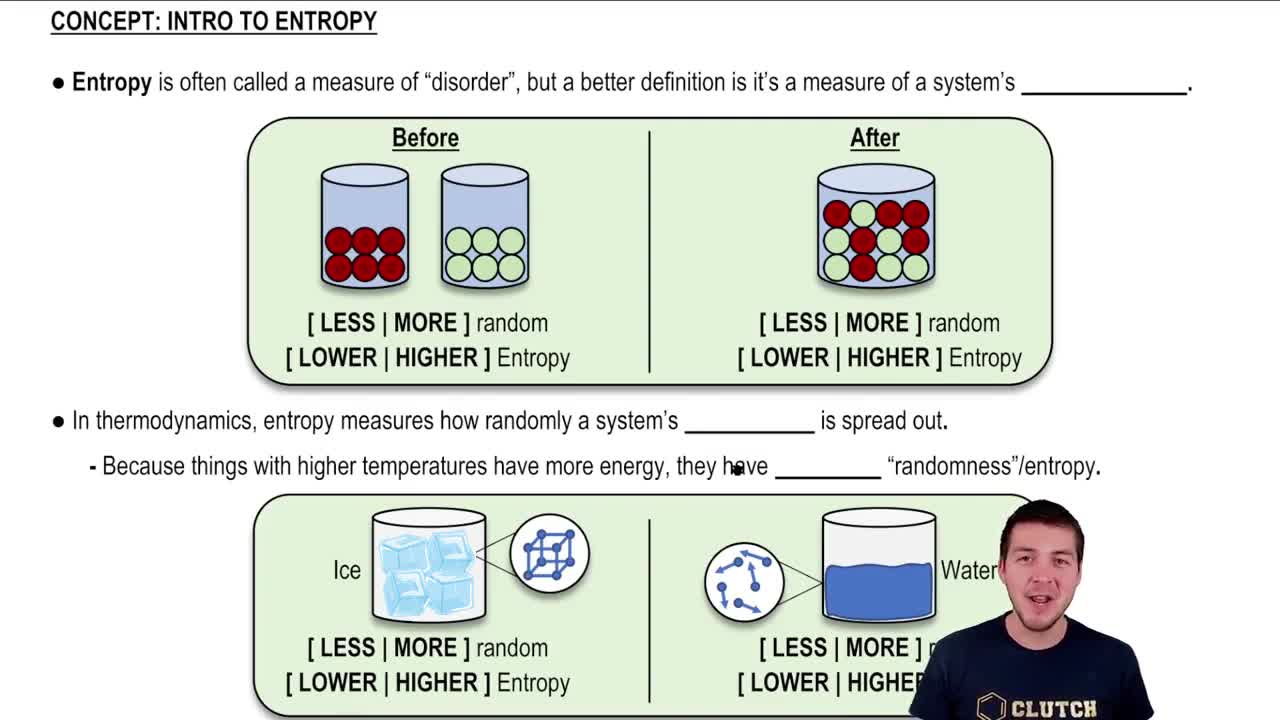
Entropy is a measure of the disorder or randomness in a system. In thermodynamics, it quantifies the amount of energy in a physical system that is not available to do work. The second law of thermodynamics states that the total entropy of an isolated system can never decrease over time, which implies that natural processes tend to move towards a state of maximum disorder.
Recommended video:
Guided course
07:50
Intro to Entropy

Gibbs Free Energy

Gibbs Free Energy (G) is a thermodynamic potential that measures the maximum reversible work obtainable from a thermodynamic system at constant temperature and pressure. It is defined as G = H - TS, where H is enthalpy, T is temperature, and S is entropy. Changes in Gibbs Free Energy can predict the direction of chemical reactions and phase changes, with negative changes indicating spontaneous processes.
Recommended video:
Guided course
08:20
Mean Free Path

Mixing of Gases

The mixing of gases refers to the process where two or more different gases combine to form a homogeneous mixture. This process increases the entropy of the system because the number of accessible microstates increases as the gases intermingle. The entropy of mixing can be quantitatively expressed using the formula ΔS_mixing = -R(nA ln(fA) + nB ln(fB)), where R is the gas constant, and nA and nB are the number of moles of gases A and B, respectively.
Recommended video:
Guided course
06:12
Internal Energy of Ideal Monoatomic Gases
Related Practice
Textbook Question

The 2010 Nobel Prize in Physics was awarded for the discovery of graphene, a two-dimensional form of carbon in which the atoms form a two-dimensional crystal-lattice sheet only one atom thick. Predict the molar specific heat of graphene. Give your answer as a multiple of R.

749
views
Textbook Question

The rms speed of the molecules in 1.0 g of hydrogen gas is 1800 m/s. 500 J of work are done to compress the gas while, in the same process, 1200 J of heat energy are transferred from the gas to the environment. Afterward, what is the rms speed of the molecules?

941
views
Textbook Question

n1 moles of a monatomic gas and n2 moles of a diatomic gas are mixed together in a container. Derive an expression for the molar specific heat at constant volume of the mixture.

598
views
Textbook Question

An experiment you're designing needs a gas with γ = 1.50. You recall from your physics class that no individual gas has this value, but it occurs to you that you could produce a gas with γ = 1.50 by mixing together a monatomic gas and a diatomic gas. What fraction of the molecules need to be monatomic?

92
views
Textbook Question

Consider a container like that shown in Figure, with n1n_1 moles of a monatomic gas on one side and n2n_2 moles of a diatomic gas on the other. The monatomic gas has initial temperature T1iT_{1i}. The diatomic gas has initial temperature T2iT_{2i}. Show that the equilibrium thermal energies are

E1f=3n13n1+5n2(E1i+E2i)E2f=5n23n1+5n2(E1i+E2i)\begin{aligned}E_{1f} &= \frac{3n_1}{3n_1 + 5n_2} (E_{1i} + E_{2i}) \\E_{2f} &= \frac{5n_2}{3n_1 + 5n_2} (E_{1i} + E_{2i})\end{aligned}

467
views
Textbook Question

Consider a container like that shown in the Figure, with n1n_1 moles of a monatomic gas on one side and n2n_2 moles of a diatomic gas on the other. The monatomic gas has initial temperature T1iT_{1i}. The diatomic gas has initial temperature T2iT_{2i}. Show that the equilibrium temperature is


Tf=3n1T1i+5n2T2i3n1+5n2T_f = \frac{3n_1 T_{1i} + 5n_2 T_{2i}}{3n_1 + 5n_2}

570
views