
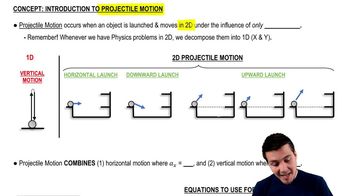
In a carnival booth, you can win a stuffed giraffe if you toss a quarter into a small dish. The dish is on a shelf above the point where the quarter leaves your hand and is a horizontal distance of 2.1 m from this point (Fig. E3.19). If you toss the coin with a velocity of 6.4 m/s at an angle of 60° above the horizontal, the coin will land in the dish. Ignore air resistance. What is the height of the shelf above the point where the quarter leaves your hand?
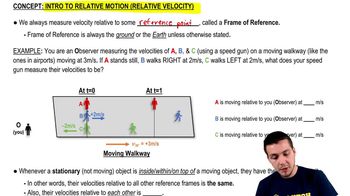
A 124 kg balloon carrying a 22 kg basket is descending with a constant downward velocity of 20.0 m/s. A 1.0 kg stone is thrown from the basket with an initial velocity of 15.0 m/s perpendicular to the path of the descending balloon, as measured relative to a person at rest in the basket. That person sees the stone hit the ground 5.00 s after it was thrown. Assume that the balloon continues its downward descent with the same constant speed of 20.0 m/s. How high is the balloon when the rock is thrown?
Verified step by step guidance
Verified video answer for a similar problem:
Key Concepts
Relative Velocity
Projectile Motion
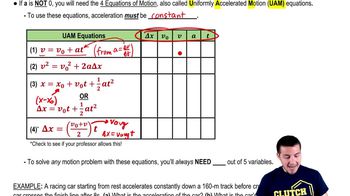
Kinematic Equations
In a carnival booth, you can win a stuffed giraffe if you toss a quarter into a small dish. The dish is on a shelf above the point where the quarter leaves your hand and is a horizontal distance of 2.1 m from this point (Fig. E3.19). If you toss the coin with a velocity of 6.4 m/s at an angle of 60° above the horizontal, the coin will land in the dish. Ignore air resistance. What is the vertical component of the velocity of the quarter just before it lands in the dish?
A man stands on the roof of a 15.0-m-tall building and throws a rock with a speed of 30.0 m/s at an angle of 33.0° above the horizontal. Ignore air resistance. Calculate Draw x-t, y-t, vx–t, and vy–t graphs for the motion.
A 124 kg balloon carrying a 22 kg basket is descending with a constant downward velocity of 20.0 m/s. A 1.0 kg stone is thrown from the basket with an initial velocity of 15.0 m/s perpendicular to the path of the descending balloon, as measured relative to a person at rest in the basket. That person sees the stone hit the ground 5.00 s after it was thrown. Assume that the balloon continues its downward descent with the same constant speed of 20.0 m/s. At the instant the rock hits the ground, how far is it from the basket?
The earth has a radius of 6380 km and turns around once on its axis in 24 h. What is the radial acceleration of an object at the earth's equator? Give your answer in m/s2 and as a fraction of g.
The earth has a radius of 6380 km and turns around once on its axis in 24 h. If arad at the equator is greater than g, objects will fly off the earth's surface and into space. (We will see the reason for this in Chapter 5.) What would the period of the earth's rotation have to be for this to occur?
