
Ch 04: Newton's Laws of Motion
Chapter 4, Problem 8a

You walk into an elevator, step onto a scale, and push the 'up' button. You recall that your normal weight is 625625 N. Draw a free-body diagram. When the elevator has an upward acceleration of magnitude 2.502.50 m/s2, what does the scale read?

Verified step by step guidance
1
Step 1: Begin by identifying the forces acting on you while standing on the scale in the elevator. These forces include your weight (gravitational force, Fg = mg) acting downward and the normal force (Fn) exerted by the scale acting upward. The scale reading corresponds to the magnitude of the normal force.
Step 2: Write Newton's second law for the vertical direction: \( F_{net} = ma \). Here, \( F_{net} \) is the net force acting on you, \( m \) is your mass, and \( a \) is the acceleration of the elevator. The net force is given by \( F_{net} = F_n - F_g \), where \( F_n \) is the normal force and \( F_g \) is your weight.
Step 3: Calculate your mass using your normal weight. Recall that \( F_g = mg \), where \( g \) is the acceleration due to gravity (approximately \( 9.8 \, \text{m/s}^2 \)). Rearrange to find \( m = \frac{F_g}{g} \). Substitute \( F_g = 625 \, \text{N} \) and \( g = 9.8 \, \text{m/s}^2 \) to determine your mass.
Step 4: Substitute the values of \( m \), \( g \), and \( a \) into the equation \( F_n = F_g + ma \). Here, \( F_g \) is your weight, \( m \) is your mass, and \( a \) is the upward acceleration of the elevator (\( 2.50 \, \text{m/s}^2 \)). This equation accounts for the additional force required to accelerate you upward.
Step 5: Solve for \( F_n \), which represents the scale reading. The result will be the sum of your normal weight and the additional force due to the elevator's upward acceleration. Ensure all units are consistent during substitution and calculation.

Verified video answer for a similar problem:

This video solution was recommended by our tutors as helpful for the problem above.
Was this helpful?

Key Concepts

Here are the essential concepts you must grasp in order to answer the question correctly.

Free-Body Diagram

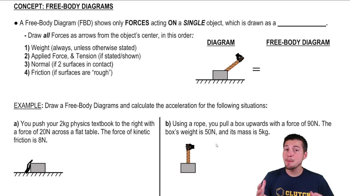
A free-body diagram is a graphical representation used to visualize the forces acting on an object. In this case, it would illustrate the forces on the person in the elevator, including gravitational force (weight) acting downward and the normal force exerted by the scale acting upward. This helps in analyzing the net force and acceleration of the object.
Recommended video:
Guided course
08:42
Free-Body Diagrams

Newton's Second Law of Motion

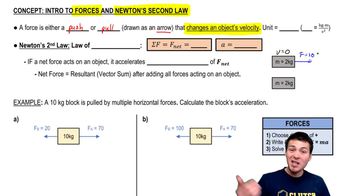
Newton's Second Law states that the acceleration of an object is directly proportional to the net force acting on it and inversely proportional to its mass, expressed as F = ma. In the context of the elevator, this law helps determine the net force when the elevator accelerates upward, allowing us to calculate the apparent weight shown on the scale.
Recommended video:
Guided course
06:54
Intro to Forces & Newton's Second Law

Apparent Weight

Apparent weight is the normal force experienced by an object in a non-inertial frame, such as an accelerating elevator. It differs from true weight due to the effects of acceleration. When the elevator accelerates upward, the apparent weight increases, which is what the scale measures, reflecting the combined effect of gravitational force and the additional force due to the elevator's acceleration.
Recommended video:
Guided course
10:19
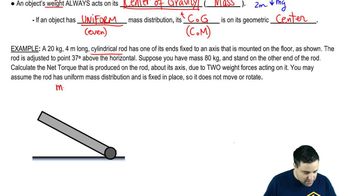
Torque Due to Weight
Related Practice
Textbook Question

Due to a jaw injury, a patient must wear a strap (Fig. E4.34.3) that produces a net upward force of 5.005.00 N on his chin. The tension is the same throughout the strap. To what tension must the strap be adjusted to provide the necessary upward force?

<IMAGE>

10757
views
14
rank
1
comments
Textbook Question

A man is dragging a trunk up the loading ramp of a mover's truck. The ramp has a slope angle of 20.020.0°, and the man pulls upward with a force F\overrightarrow{F} whose direction makes an angle of 30.030.0° with the ramp (Fig. E4.44.4). How large a force F\overrightarrow{F} is necessary for the component FxF_{x} parallel to the ramp to be 90.090.0 N?

<IMAGE>

646
views
Textbook Question

A man is dragging a trunk up the loading ramp of a mover's truck. The ramp has a slope angle of 20.020.0°, and the man pulls upward with a force F\overrightarrow{F} whose direction makes an angle of 30.030.0° with the ramp (Fig. E4.44.4). How large will the component FyF_y perpendicular to the ramp be then?

<IMAGE>

2874
views
Textbook Question

You walk into an elevator, step onto a scale, and push the 'up' button. You recall that your normal weight is 625625 N. Draw a free-body diagram. If you hold a 3.853.85-kg package by a light vertical string, what will be the tension in this string when the elevator accelerates as in part (a)? Note: Part (a) asked what does the scale read when the elevator has an upward acceleration of magnitude 2.502.50 m/s2.

2391
views
1
rank
Textbook Question

A box rests on a frozen pond, which serves as a frictionless horizontal surface. If a fisherman applies a horizontal force with magnitude 48.048.0 N to the box and produces an acceleration of magnitude 2.202.20 m/s2, what is the mass of the box?

1426
views
Textbook Question

A dockworker applies a constant horizontal force of 80.080.0 N to a block of ice on a smooth horizontal floor. The frictional force is negligible. The block starts from rest and moves 11.011.0 m in 5.00 5.00 s. What is the mass of the block of ice?

1430
views