
Pearson+ LogoPearson+ Logo
Ch 05: Applying Newton's Laws
Young & Freedman Calc - University Physics 14th Edition
Young & Freedman Calc14th EditionUniversity PhysicsISBN: 9780321973610Not the one you use?Change textbook
Chapter 5, Problem 54d

The Cosmo Clock 21 Ferris wheel in Yokohama, Japan, has a diameter of 100100 m. Its name comes from its 6060 arms, each of which can function as a second hand (so that it makes one revolution every 60.060.0 s). What then would be the passenger's apparent weight at the lowest point?

Verified step by step guidance
1
Determine the centripetal acceleration of the passenger at the lowest point. The centripetal acceleration is given by the formula: acr=v2/r, where v is the tangential speed and r is the radius of the Ferris wheel.
Calculate the tangential speed v of the passenger. The tangential speed is related to the period of rotation T and the radius r by the formula: v=2πrT. Use the diameter of the Ferris wheel to find the radius r=1002=50 m, and the period T=60 s.
Determine the net force acting on the passenger at the lowest point. At this point, the forces acting on the passenger are the gravitational force Fg=mg (downward) and the normal force Fn (upward). The net force is the centripetal force required to keep the passenger moving in a circular path: Fc=macr.
Relate the normal force to the net force. At the lowest point, the normal force is greater than the gravitational force because it must provide the centripetal force in addition to balancing the passenger's weight. The relationship is: Fn=Fg+Fc, or equivalently: Fn=mg+macr.
Substitute the expressions for acr and v into the equation for Fn. This gives: Fn=mg+m2πrT2r. Simplify this expression to find the apparent weight of the passenger at the lowest point.

Verified video answer for a similar problem:

This video solution was recommended by our tutors as helpful for the problem above.
Video duration:
3m
Was this helpful?

Key Concepts

Here are the essential concepts you must grasp in order to answer the question correctly.

Centripetal Acceleration

Centripetal acceleration is the acceleration directed towards the center of a circular path that an object follows. It is necessary for maintaining circular motion and is calculated using the formula a_c = v^2 / r, where v is the tangential speed and r is the radius of the circular path. In the context of the Ferris wheel, this acceleration affects the forces acting on the passengers as they move along the circular trajectory.
Recommended video:
Guided course
06:48
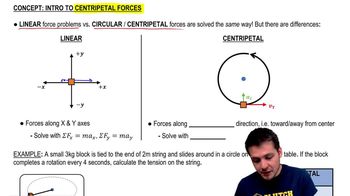
Intro to Centripetal Forces

Apparent Weight

Apparent weight refers to the sensation of weight experienced by an object or person, which can differ from actual weight due to acceleration. It is influenced by the net forces acting on the object, including gravitational force and any additional forces due to motion, such as centripetal force. At the lowest point of the Ferris wheel, the apparent weight is the sum of the gravitational force and the centripetal force required to keep the passenger moving in a circle.
Recommended video:
Guided course
10:19
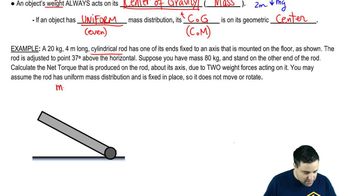
Torque Due to Weight

Forces in Circular Motion

In circular motion, several forces interact to keep an object moving along a curved path. The key forces include gravitational force, which pulls objects downward, and the normal force, which acts perpendicular to the surface. At the lowest point of the Ferris wheel, the normal force is greater than the gravitational force, resulting in an increased apparent weight for the passengers due to the need for centripetal force to maintain circular motion.
Recommended video:
Guided course
03:48
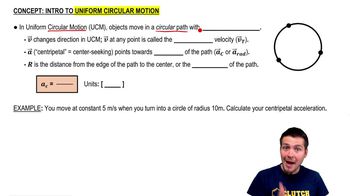
Intro to Circular Motion