
Ch 12: Fluid Mechanics
Young & Freedman Calc - University Physics 14th Edition
Young & Freedman Calc14th EditionUniversity PhysicsISBN: 9780321973610Not the one you use?Change textbook
Chapter 12, Problem 25b

Exploring Venus. The surface pressure on Venus is 92 atm, and the acceleration due to gravity there is 0.894g. In a future exploratory mission, an upright cylindrical tank of benzene is sealed at the top but still pressurized at 92 atm just above the benzene. The tank has a diameter of 1.72 m, and the benzene column is 11.50 m tall. Ignore any effects due to the very high temperature on Venus. What force does the Venusian atmosphere exert on the outside surface of the bottom of the tank?

Verified step by step guidance
1
First, understand that the force exerted by the Venusian atmosphere on the outside surface of the bottom of the tank is due to the atmospheric pressure acting over the area of the bottom surface.
Calculate the area of the bottom of the cylindrical tank using the formula for the area of a circle: \( A = \pi r^2 \), where \( r \) is the radius of the tank. Given the diameter is 1.72 m, the radius \( r \) is half of that.
Convert the atmospheric pressure from atmospheres to pascals (Pa) for consistency in units. Use the conversion factor: 1 atm = 101325 Pa.
Calculate the force exerted by the atmosphere using the formula: \( F = P \times A \), where \( P \) is the pressure in pascals and \( A \) is the area calculated in step 2.
Substitute the values for pressure and area into the force equation to find the force exerted by the Venusian atmosphere on the bottom of the tank.

Verified video answer for a similar problem:

This video solution was recommended by our tutors as helpful for the problem above.
Video duration:
4m
Was this helpful?

Key Concepts

Here are the essential concepts you must grasp in order to answer the question correctly.

Pressure

Pressure is defined as the force exerted per unit area. In this context, the pressure exerted by the Venusian atmosphere is 92 atm, which is significantly higher than Earth's atmospheric pressure. Understanding pressure is crucial for calculating the force exerted on surfaces, as it directly influences the force applied over a given area.
Recommended video:
Guided course
17:04
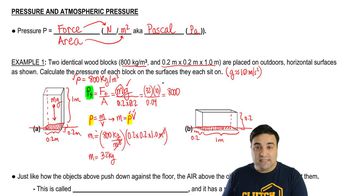
Pressure and Atmospheric Pressure

Force

Force is a vector quantity that represents the interaction that changes the motion of an object. It is calculated as the product of pressure and area (F = P × A). In this problem, the force exerted by the atmosphere on the tank's bottom surface is determined by multiplying the atmospheric pressure by the area of the tank's bottom.
Recommended video:
Guided course
06:48
Intro to Centripetal Forces

Area of a Circle

The area of a circle is calculated using the formula A = πr², where r is the radius of the circle. For the cylindrical tank, the diameter is given as 1.72 m, so the radius is half of that. Calculating the area of the tank's bottom is essential for determining the force exerted by the atmospheric pressure on it.
Recommended video:
Guided course
04:05
Calculating Work As Area Under F-x Graphs
Related Practice
Textbook Question

BIO. The lower end of a long plastic straw is immersed below the surface of the water in a plastic cup. An average person sucking on the upper end of the straw can pull water into the straw to a vertical height of 1.1 m above the surface of the water in the cup. (a) What is the lowest gauge pressure that the average person can achieve inside his lungs? (b) Explain why your answer in part (a) is negative.

1992
views
Textbook Question

A closed container is partially filled with water. Initially, the air above the water is at atmospheric pressure (1.01×10⁵ Pa) and the gauge pressure at the bottom of the water is 2500 Pa. Then additional air is pumped in, increasing the pressure of the air above the water by 1500 Pa. What is the gauge pressure at the bottom of the water?

2029
views
Textbook Question

Hydraulic Lift II.The piston of a hydraulic automobile lift is 0.30 m in diameter. What gauge pressure, in pascals, is required to lift a car with a mass of 1200 kg? Also express this pressure in atmospheres.

1416
views
1
rank
Textbook Question

A rock has mass 1.80 kg. When the rock is suspended from the lower end of a string and totally immersed in water, the tension in the string is 12.8 N. What is the smallest density of a liquid in which the rock will float?

1620
views
Textbook Question

A 950-kg cylindrical can buoy floats vertically in sea-water. The diameter of the buoy is 0.900 m. Calculate the additional distance the buoy will sink when an 80.0-kg man stands on top of it.

1784
views
1
rank
Textbook Question

A slab of ice floats on a freshwater lake. What minimum volume must the slab have for a 65.0-kg woman to be able to stand on it without getting her feet wet?

1966
views
1
rank