
Ch 13: Gravitation
Young & Freedman Calc - University Physics 14th Edition
Young & Freedman Calc14th EditionUniversity PhysicsISBN: 9780321973610Not the one you use?Change textbook
Chapter 13, Problem 11

At what distance above the surface of the earth is the acceleration due to the earth's gravity 0.980 m/s2 if the acceleration due to gravity at the surface has magnitude 9.80 m/s2 ?

Verified step by step guidance
1
Start by understanding that the acceleration due to gravity decreases with distance from the Earth's surface. This is described by the formula: g=GMr2, where G is the gravitational constant, M is the mass of the Earth, and r is the distance from the center of the Earth.
Recognize that at the Earth's surface, the acceleration due to gravity is g=9.80 m/s2. This can be expressed as GMR2, where R is the radius of the Earth.
Set up the equation for the acceleration due to gravity at the desired height: GMR+h2=0.980, where h is the height above the Earth's surface.
Divide the equation for the acceleration at height by the equation for the acceleration at the surface: 0.9809.80=R2R+h2. Simplify this to find a relationship between R and h.
Solve the simplified equation for h to find the height above the Earth's surface where the acceleration due to gravity is 0.980 m/s2. This involves algebraic manipulation and possibly using the quadratic formula.

Verified video answer for a similar problem:

This video solution was recommended by our tutors as helpful for the problem above.
Video duration:
6m
Was this helpful?

Key Concepts

Here are the essential concepts you must grasp in order to answer the question correctly.

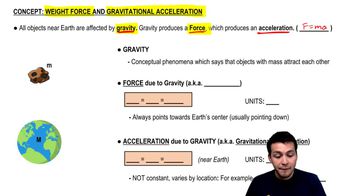
Gravitational Acceleration

Gravitational acceleration is the rate at which an object accelerates due to the force of gravity. On Earth's surface, this is approximately 9.80 m/s². It decreases with altitude as the distance from the Earth's center increases, following the inverse square law.
Recommended video:
Guided course
07:32
Weight Force & Gravitational Acceleration

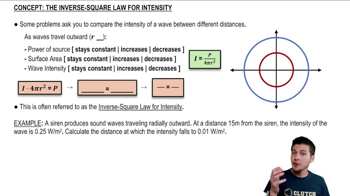
Inverse Square Law

The inverse square law states that a physical quantity or strength is inversely proportional to the square of the distance from the source. For gravity, this means that as you move away from the Earth, the gravitational force decreases with the square of the distance, affecting the acceleration experienced.
Recommended video:
Guided course
05:26
The Inverse-Square Law for Intensity

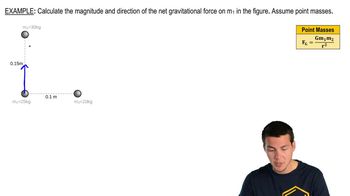
Gravitational Force Equation

The gravitational force equation, F = G(m1*m2)/r², describes the force between two masses. Here, G is the gravitational constant, m1 and m2 are the masses, and r is the distance between their centers. This equation helps calculate how gravity changes with distance, crucial for finding the altitude where gravity is 0.980 m/s².
Recommended video:
Guided course
05:41
Gravitational Forces in 2D