Ch 14: Periodic Motion
Young & Freedman Calc - University Physics 14th Edition
Young & Freedman Calc14th EditionUniversity PhysicsISBN: 9780321973610Not the one you use?Change textbook
Chapter 14, Problem 4ab

The displacement of an oscillating object as a function of time is shown in Fig. E14.4. What is (a) the frequency? (b) the amplitude?
Graph depicting the displacement of an oscillating object over time in simple harmonic motion.

Verified step by step guidance
1
To find the amplitude, observe the maximum displacement from the equilibrium position on the graph. The amplitude is the distance from the center line to the peak of the wave.
To determine the period, identify the time it takes for the wave to complete one full cycle. This can be measured by finding the time interval between two consecutive peaks or troughs.
The frequency is the reciprocal of the period. Use the formula \( f = \frac{1}{T} \), where \( T \) is the period.
The angular frequency can be calculated using the formula \( \omega = 2\pi f \), where \( f \) is the frequency.
Verify each calculation by cross-referencing the values obtained from the graph to ensure consistency and accuracy.

Verified video answer for a similar problem:

This video solution was recommended by our tutors as helpful for the problem above.
Video duration:
3m
Was this helpful?

Key Concepts

Here are the essential concepts you must grasp in order to answer the question correctly.

Frequency

Frequency is the number of complete cycles of oscillation that occur in a unit of time, typically measured in hertz (Hz). In the context of the graph, it can be determined by identifying the time period of one complete oscillation and taking the reciprocal of that period. For example, if one cycle takes 10 seconds, the frequency would be 0.1 Hz.
Recommended video:
Guided course
05:08
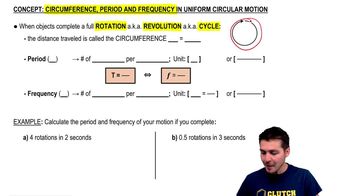
Circumference, Period, and Frequency in UCM

Amplitude

Amplitude refers to the maximum displacement of an oscillating object from its equilibrium position. In the provided graph, the amplitude can be identified as the maximum value of displacement, which is the peak height of the wave. For instance, if the graph reaches a maximum of 10 cm and a minimum of -10 cm, the amplitude is 10 cm.
Recommended video:
Guided course
04:24
Amplitude Decay in an LRC Circuit

Simple Harmonic Motion (SHM)

Simple Harmonic Motion is a type of periodic motion where the restoring force is directly proportional to the displacement from the equilibrium position and acts in the opposite direction. This motion is characterized by a sinusoidal displacement-time graph, like the one shown. Understanding SHM is crucial for analyzing the frequency and amplitude of oscillating systems.
Recommended video:
Guided course
07:52
Simple Harmonic Motion of Pendulums