Here are the essential concepts you must grasp in order to answer the question correctly.
Angular Frequency in L-R-C Circuits
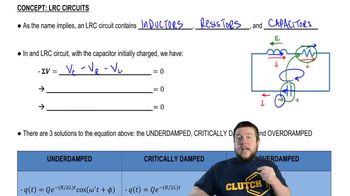
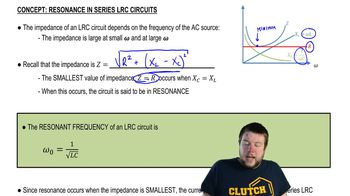
Angular frequency in an L-R-C circuit is determined by the formula ω = 1/√(LC), where L is inductance and C is capacitance. This frequency represents the rate of oscillation of the circuit's current and voltage. In the context of the question, understanding how resistance affects this frequency is crucial for determining the required decrease.
Recommended video:
Damping in RLC Circuits
Damping refers to the reduction in amplitude of oscillations in a circuit due to resistance. In an L-R-C circuit, resistance causes energy loss, affecting the angular frequency. The damping factor, which includes resistance, modifies the natural frequency, leading to a decrease in angular frequency as resistance increases.
Recommended video:
Quality Factor and Resonance
The quality factor (Q) of an L-R-C circuit is a measure of its resonance sharpness, defined as Q = ωL/R. It indicates how underdamped the circuit is, affecting the angular frequency. A decrease in Q due to increased resistance results in a lower angular frequency, which is essential for calculating the required resistance for a specific frequency change.
Recommended video:
Resonance in Series LRC Circuits