
Ch 36: Diffraction
Chapter 35, Problem 17a

A single-slit diffraction pattern is formed by monochromatic electromagnetic radiation from a distant source passing through a slit 0.105 mm wide. At the point in the pattern 3.25° from the center of the central maximum, the total phase difference between wavelets from the top and bottom of the slit is 56.0 rad. What is the wavelength of the radiation?

Verified step by step guidance
1
Understand the relationship between the phase difference and the path difference in a single-slit diffraction pattern. The phase difference \( \Delta \phi \) is related to the path difference \( \Delta x \) by the formula \( \Delta \phi = \frac{2 \pi \Delta x}{\lambda} \), where \( \lambda \) is the wavelength of the radiation.
Determine the path difference \( \Delta x \) for the wavelets from the top and bottom of the slit. The path difference is given by \( \Delta x = a \sin \theta \), where \( a \) is the width of the slit (0.105 mm) and \( \theta \) is the angle from the central maximum (3.25°).
Substitute the expression for \( \Delta x \) into the phase difference formula: \( \Delta \phi = \frac{2 \pi (a \sin \theta)}{\lambda} \). Rearrange this equation to solve for the wavelength \( \lambda \): \( \lambda = \frac{2 \pi a \sin \theta}{\Delta \phi} \).
Convert all quantities to consistent units. Ensure the slit width \( a \) is in meters (0.105 mm = 0.105 × 10^{-3} m), the angle \( \theta \) is in radians (3.25° = 3.25 × \frac{\pi}{180} radians), and the phase difference \( \Delta \phi \) is in radians (already given as 56.0 rad).
Substitute the numerical values for \( a \), \( \sin \theta \), and \( \Delta \phi \) into the formula for \( \lambda \) to calculate the wavelength. The result will be in meters, which can be converted to nanometers if needed (1 m = 10^9 nm).

Verified video answer for a similar problem:

This video solution was recommended by our tutors as helpful for the problem above.
Video duration:
3m
Was this helpful?

Key Concepts

Here are the essential concepts you must grasp in order to answer the question correctly.

Diffraction

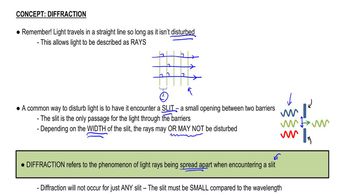
Diffraction is the bending of waves around obstacles and the spreading of waves when they pass through narrow openings. In the context of light, diffraction patterns arise when waves encounter a slit, leading to interference effects that create a series of bright and dark fringes. The extent of diffraction depends on the wavelength of the light and the size of the slit.
Recommended video:

Phase Difference

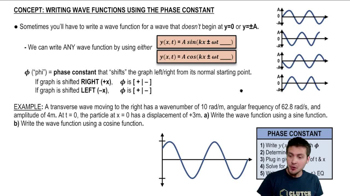
Phase difference refers to the difference in the phase of two waves at a given point in time, often measured in radians. In diffraction, the phase difference between wavelets emanating from different parts of a slit affects the interference pattern observed. A phase difference of 2π radians corresponds to a full cycle of the wave, while other values lead to constructive or destructive interference.
Recommended video:
Guided course
08:59
Phase Constant of a Wave Function

Wavelength

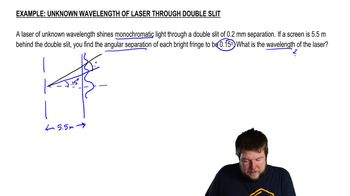
Wavelength is the distance between successive peaks (or troughs) of a wave, typically denoted by the symbol λ. It is a fundamental property of waves, including electromagnetic radiation, and is inversely related to frequency. In diffraction problems, the wavelength can be determined using the geometry of the setup and the observed phase differences, as it influences the pattern's spacing and intensity.
Recommended video:
Guided course
05:42
Unknown Wavelength of Laser through Double Slit
Related Practice
Textbook Question

A slit 0.240 mm wide is illuminated by parallel light rays of wavelength 540 nm. The diffraction pattern is observed on a screen that is 3.00 m from the slit. The intensity at the center of the central maximum (θ = 0°) is 6.00 x 10⁻⁶ W/m2. What is the distance on the screen from the center of the central maximum to the first minimum?

669
views
Textbook Question

A slit 0.240 mm wide is illuminated by parallel light rays of wavelength 540 nm. The diffraction pattern is observed on a screen that is 3.00 m from the slit. The intensity at the center of the central maximum (θ = 0°) is 6.00 x 10⁻⁶ W/m2. What is the intensity at a point on the screen midway between the center of the central maximum and the first minimum?

752
views
Textbook Question

Monochromatic light of wavelength 592 nm from a distant source passes through a slit that is 0.0290 mm wide. In the resulting diffraction pattern, the intensity at the center of the central maximum (θ = 0°) is 4.00x10⁻⁵ W/m2. What is the intensity at a point on the screen that corresponds to θ = 1.20°?

1141
views
Textbook Question

A single-slit diffraction pattern is formed by monochromatic electromagnetic radiation from a distant source passing through a slit 0.105 mm wide. At the point in the pattern 3.25° from the center of the central maximum, the total phase difference between wavelets from the top and bottom of the slit is 56.0 rad. What is the intensity at this point, if the intensity at the center of the central maximum is I0?

678
views
Textbook Question

Parallel rays of monochromatic light with wavelength 568 nm illuminate two identical slits and produce an interference pattern on a screen that is 75.0 cm from the slits. The centers of the slits are 0.640 mm apart and the width of each slit is 0.434 mm. If the intensity at the center of the central maximum is 5.00 x 10⁻⁴ W/m2, what is the intensity at a point on the screen that is 0.900 mm from the center of the central maximum?

1038
views
Textbook Question

Laser light of wavelength 500.0 nm illuminates two identical slits, producing an interference pattern on a screen 90.0 cm from the slits. The bright bands are 1.00 cm apart, and the third bright bands on either side of the central maximum are missing in the pattern. Find the width and the separation of the two slits.

1043
views
1
rank