Euler Paths and Euler Circuits: Videos & Practice Problems
Euler Paths and Euler Circuits focus on tracing a graph so that each edge is used exactly once. An Euler path is a path that travels along every edge exactly once, while an Euler circuit is a circuit that also uses every edge exactly once and returns to the starting vertex. Because a circuit is closed, its starting and ending vertex are the same.
To classify a sequence of vertices, trace the graph in order and check two ideas: whether every listed step follows an actual edge, and whether all edges of the graph are included exactly once. If the sequence uses each edge exactly once and starts and ends at different vertices, it is an Euler path. If it uses each edge exactly once and starts and ends at the same vertex, it is an Euler circuit. If any edge is missed, repeated, or the sequence does not form the required path or circuit, the result is neither.
Euler Paths and Euler Circuits


Using the graph below, determine if the sequence of vertices describes an Euler path (E.P.), an Euler circuit (E.C.), or neither.
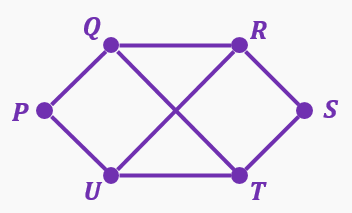
E.P.
E.C.
NEITHER
Using the graph below, determine if the sequence of vertices describes an Euler path (E.P.), an Euler circuit (E.C.), or neither.
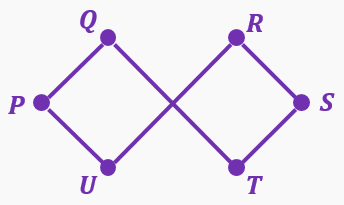
E.P.
E.C.
NEITHER
Using the graph below, determine if the sequence of vertices describes an Euler path (E.P.), an Euler circuit (E.C.), or neither.
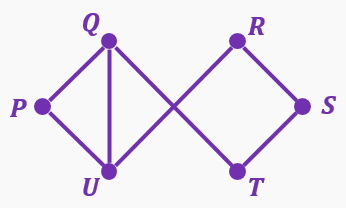
E.P.
E.C.
NEITHER
Euler Paths and Euler Circuits Example 1
Euler Paths and Euler Circuits Example 2
Euler Paths and Euler Circuits Example 3
Here's what students ask on this topic:
An Euler path is a trail in a graph that uses every edge exactly once but does not necessarily start and end at the same vertex. In contrast, an Euler circuit is a special type of Euler path that starts and ends at the same vertex, forming a closed loop. Both concepts require that each edge in the graph is traversed exactly once. The key difference lies in the starting and ending points: an Euler path has different start and end vertices, while an Euler circuit has the same start and end vertex. Understanding this distinction is crucial when analyzing graphs for these paths or circuits.
To determine if a sequence of vertices represents an Euler path or circuit, first verify that each consecutive pair of vertices in the sequence corresponds to an actual edge in the graph. Next, check that every edge in the graph is used exactly once in the sequence. If all edges are included without repetition and the sequence starts and ends at the same vertex, it is an Euler circuit. If it starts and ends at different vertices but still uses every edge exactly once, it is an Euler path. If any edge is missed or repeated, or the sequence does not follow the graph's edges, it is neither an Euler path nor an Euler circuit.
A graph has an Euler circuit if and only if it is connected and every vertex has an even degree (an even number of edges incident to it). This ensures that you can start at any vertex and return to it after traversing every edge exactly once. If any vertex has an odd degree, the graph cannot have an Euler circuit, though it might still have an Euler path if exactly two vertices have odd degrees. These conditions are fundamental in graph theory and help quickly identify the existence of Euler circuits.
Yes, a graph can have an Euler path but not an Euler circuit. This occurs when the graph is connected and exactly two vertices have an odd degree, while all other vertices have even degrees. In this case, the Euler path starts at one of the odd-degree vertices and ends at the other, using every edge exactly once but not forming a closed loop. If more than two vertices have an odd degree, the graph has neither an Euler path nor an Euler circuit. Understanding these degree conditions helps in classifying the graph's traversability.
Using each edge exactly once in Euler paths and circuits is essential because the concept focuses on traversing every connection in the graph without repetition. This ensures a complete coverage of the graph's structure, which is useful in applications like route planning, network analysis, and solving puzzles. Reusing edges would violate the definition and could lead to incomplete or inefficient traversals. Therefore, the uniqueness of edge usage is a defining characteristic that distinguishes Euler paths and circuits from other types of graph walks.