Paths and Circuits: Videos & Practice Problems
Paths and Circuits focus on tracing a sequence of vertices in a graph by moving along a single unique edge from one vertex to the next. A sequence is a path when each consecutive pair of vertices is connected by one edge and the starting and ending vertices are different. A circuit follows the same idea, but it starts and ends at the same vertex. If any step in the sequence cannot be made along one edge, the sequence is neither.
To classify a sequence, check each move in order and verify that every pair of neighboring vertices is connected. A loop can count as an edge from a vertex back to itself. The length of a path is the number of edges used along the route \(\text{length}=\text{number of edges}\). It is also useful to identify which edges belong to a path and which edges are not part of it.
Paths and Circuits


Using the graph below, determine which edges are NOT part of the path .
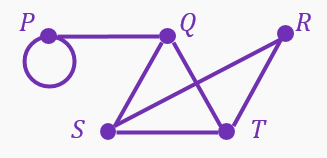
Loop at vertex P, QT, QS
Loop at vertex P, QT, RS
QS, ST, TR
PQ, RS, TR
What is the length of the path ?
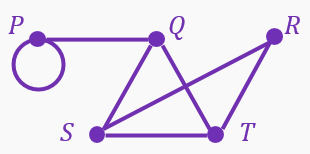
5
3
4
6
Referring to the graph below, determine if each sequence of vertices is a path, circuit, or neither.
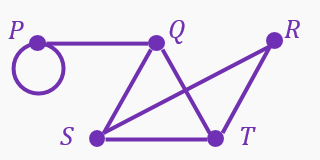
PATH
CIRCUIT
NEITHER
Referring to the graph below, determine if each sequence of vertices is a path, circuit, or neither.
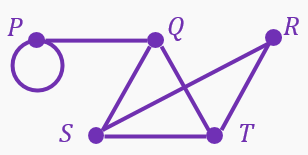
PATH
CIRCUIT
NEITHER
Referring to the graph below, determine if each sequence of vertices is a path, circuit, or neither.
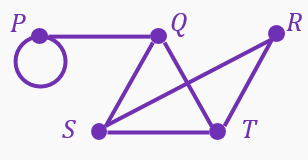
PATH
CIRCUIT
NEITHER
Paths and Circuits Example 1
Paths and Circuits Example 2
Here's what students ask on this topic:
In graph theory, a path is a sequence of vertices where each consecutive pair is connected by a unique edge, and the starting and ending vertices are different. This means you move from one vertex to another without revisiting the starting point. On the other hand, a circuit is similar but starts and ends at the same vertex, forming a closed loop. Both require that every step in the sequence follows a single edge. If any step cannot be made along one edge, the sequence is neither a path nor a circuit. Understanding these concepts is essential for analyzing routes and cycles in graphs.
The length of a path in a graph is defined as the number of edges used along the route. If you have a sequence of vertices connected by edges, you count each edge that connects consecutive vertices. For example, if a path goes through vertices , , , and , the length is the number of edges connecting these vertices, which is 3. Mathematically, . This measure helps in understanding the distance or steps needed to traverse the path.
To verify if a sequence of vertices forms a valid path or circuit, you need to check each consecutive pair of vertices to ensure they are connected by exactly one edge. For a path, the starting and ending vertices must be different, while for a circuit, they must be the same. Additionally, if any step in the sequence lacks a connecting edge, the sequence is invalid. Loops, which are edges from a vertex back to itself, can be part of circuits. This step-by-step verification ensures the sequence follows the graph's structure correctly.
Loops are edges that connect a vertex back to itself. In the context of paths and circuits, loops can be considered as edges that allow a vertex to be revisited immediately. While loops do not typically appear in simple paths (since paths usually avoid revisiting vertices), they can be part of circuits because circuits start and end at the same vertex. Including loops in circuits means the sequence can use an edge from a vertex back to itself, which can affect the length and structure of the circuit.
To identify which edges belong to a path, examine the sequence of vertices in the path and look at the edges connecting each consecutive pair. Each edge that directly connects two consecutive vertices in the sequence is part of the path. Edges not used in this sequence are not part of the path. This identification helps in visualizing the route taken through the graph and understanding which connections are involved in the traversal.