Back
Back
Problem 7
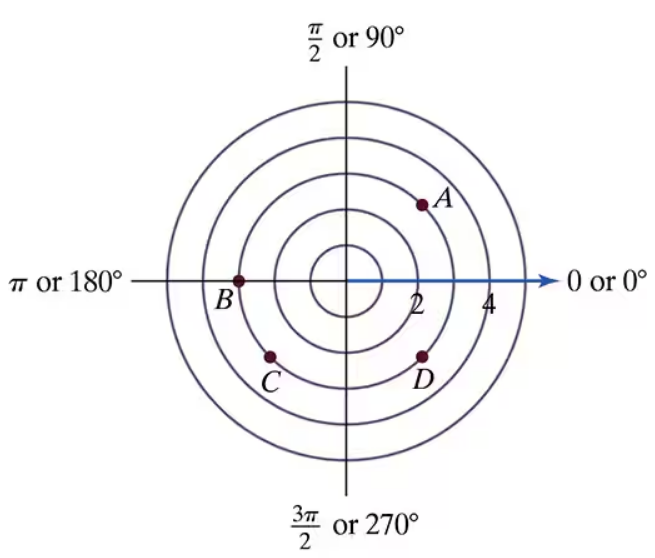
Indicate if the point with the given polar coordinates is represented by A, B, C, or D on the graph. (3, −135°)
Problem 9
Indicate if the point with the given polar coordinates is represented by A, B, C, or D on the graph. (−3, −3π/4)
Problem 11
Use a polar coordinate system like the one shown for Exercises 1–10 to plot each point with the given polar coordinates. (2, 45°)
Problem 13
Use a polar coordinate system like the one shown for Exercises 1–10 to plot each point with the given polar coordinates. (3, 90°)
Problem 15
In Exercises 11–20, use a polar coordinate system like the one shown for Exercises 1–10 to plot each point with the given polar coordinates. (3, 4π/3)
Problem 17
In Exercises 11–20, use a polar coordinate system like the one shown for Exercises 1–10 to plot each point with the given polar coordinates. (−1, π)
Problem 19
In Exercises 11–20, use a polar coordinate system like the one shown for Exercises 1–10 to plot each point with the given polar coordinates. (−2, − π/2)
Problem 21
In Exercises 21–26, use a polar coordinate system like the one shown for Exercises 1–10 to plot each point with the given polar coordinates. Then find another representation of this point in which
a. r>0, 2π < θ < 4π.
b. r<0, 0. < θ < 2π.
c. r>0, −2π. < θ < 0.
(5, π/6)
Problem 25
In Exercises 21–26, use a polar coordinate system like the one shown for Exercises 1–10 to plot each point with the given polar coordinates. Then find another representation of this point in which a. r>0, 2π < θ < 4π. b. r<0, 0. < θ < 2π. c. r>0, −2π. < θ < 0. (4, π/2)
Problem 27
In Exercises 27–32, select the representations that do not change the location of the given point. (7, 140°) (−7, 320°)
Problem 28
In Exercises 27–32, select the representations that do not change the location of the given point. (4, 120°) (−4, 300°)
Problem 29
In Exercises 27–32, select the representations that do not change the location of the given point. (2, − 3π/4) (2, − 7π/4)
Problem 30
In Exercises 27–32, select the representations that do not change the location of the given point. (−2, 7π/6) (−2, −5π/6)
Problem 31
In Exercises 27–32, select the representations that do not change the location of the given point. (−5, − π/4) (−5, 7π/4)
Problem 32
In Exercises 27–32, select the representations that do not change the location of the given point. (−6, 3π) (6, −π)
Problem 33
In Exercises 33–40, polar coordinates of a point are given. Find the rectangular coordinates of each point. (4, 90°)
Problem 37
In Exercises 33–40, polar coordinates of a point are given. Find the rectangular coordinates of each point. (−4, π/2)
Problem 39
In Exercises 33–40, polar coordinates of a point are given. Find the rectangular coordinates of each point. (7.4, 2.5)
Problem 41
In Exercises 41–48, the rectangular coordinates of a point are given. Find polar coordinates of each point. Express θ in radians. (−2, 2)
Problem 43
In Exercises 41–48, the rectangular coordinates of a point are given. Find polar coordinates of each point. Express θ in radians. _ (2,−2√3)
Problem 69
In Exercises 59–74, convert each polar equation to a rectangular equation. Then use a rectangular coordinate system to graph the rectangular equation. r = 12 cos θ
Problem 71
In Exercises 59–74, convert each polar equation to a rectangular equation. Then use a rectangular coordinate system to graph the rectangular equation.
r = 6 cos θ + 4 sin θ
Problem 79
In Exercises 79–80, convert each polar equation to a rectangular equation. Then determine the graph's slope and y-intercept.
r sin (θ − π/4) = 2
Problem 81
In Exercises 81–82, find the rectangular coordinates of each pair of points. Then find the distance, in simplified radical form, between the points. (2, 2π/3) and (4, π/6)
Problem 9
Test for symmetry with respect to a. the polar axis. b. the line θ = π/2. c. the pole. r = 4 + 3 cos θ
Problem 13
Test for symmetry and then graph each polar equation. r = 2 cos θ
Problem 15
In Exercises 13–34, test for symmetry and then graph each polar equation. r = 1 − sin θ
Problem 19
In Exercises 13–34, test for symmetry and then graph each polar equation. r = 2 + cos θ
Problem 21
In Exercises 13–34, test for symmetry and then graph each polar equation. r = 1 + 2 cos θ
Problem 23
In Exercises 13–34, test for symmetry and then graph each polar equation. r = 2 − 3 sin θ