In Exercises 49–58, convert each rectangular equation to a polar equation that expresses r in terms of θ. x = 7
Table of contents
- 0. Review of College Algebra4h 45m
- 1. Measuring Angles40m
- 2. Trigonometric Functions on Right Triangles2h 5m
- 3. Unit Circle1h 19m
- 4. Graphing Trigonometric Functions1h 19m
- 5. Inverse Trigonometric Functions and Basic Trigonometric Equations1h 41m
- 6. Trigonometric Identities and More Equations2h 34m
- 7. Non-Right Triangles1h 38m
- 8. Vectors2h 25m
- 9. Polar Equations2h 5m
- 10. Parametric Equations1h 6m
- 11. Graphing Complex Numbers1h 7m
9. Polar Equations
Convert Equations Between Polar and Rectangular Forms
Problem 5.RE.57
Textbook Question
In Exercises 54–60, convert each polar equation to a rectangular equation. Then use your knowledge of the rectangular equation to graph the polar equation in a polar coordinate system. r = 5 csc θ
Verified step by step guidance1
Recall the relationships between polar and rectangular coordinates: \(x = r \cos \theta\), \(y = r \sin \theta\), and \(r^2 = x^2 + y^2\).
Given the polar equation \(r = 5 \csc \theta\), rewrite \(\csc \theta\) in terms of sine: \(\csc \theta = \frac{1}{\sin \theta}\), so the equation becomes \(r = \frac{5}{\sin \theta}\).
Multiply both sides of the equation by \(\sin \theta\) to get \(r \sin \theta = 5\).
Use the relationship \(y = r \sin \theta\) to substitute and rewrite the equation as \(y = 5\).
Interpret the rectangular equation \(y = 5\): this represents a horizontal line 5 units above the x-axis. In the polar coordinate system, this corresponds to all points where the vertical coordinate is 5.
Verified video answer for a similar problem:This video solution was recommended by our tutors as helpful for the problem above
Video duration:
1mPlay a video:
0 Comments
Key Concepts
Here are the essential concepts you must grasp in order to answer the question correctly.
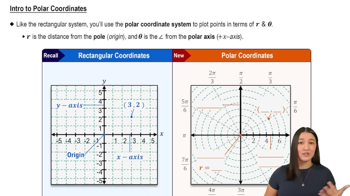
Polar and Rectangular Coordinate Systems
Polar coordinates represent points using a radius and an angle (r, θ), while rectangular coordinates use (x, y) positions on a plane. Understanding how these systems relate is essential for converting equations and interpreting graphs in both formats.
Recommended video:
Intro to Polar Coordinates
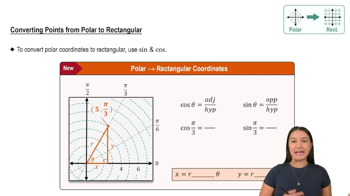
Conversion Formulas Between Polar and Rectangular Coordinates
Key formulas link polar and rectangular coordinates: x = r cos θ, y = r sin θ, and r² = x² + y². These allow transformation of equations from one system to the other, enabling easier analysis and graphing.
Recommended video:
Convert Points from Polar to Rectangular
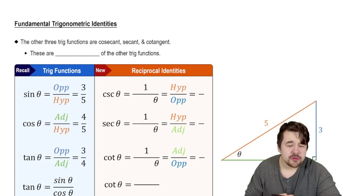
Trigonometric Functions and Their Reciprocal Identities
The equation involves csc θ, the reciprocal of sin θ (csc θ = 1/sin θ). Recognizing and manipulating these identities helps rewrite the polar equation in terms of x and y, facilitating conversion to rectangular form.
Recommended video:
Fundamental Trigonometric Identities
Related Videos
Related Practice
Textbook Question
678
views