An intravenous saline drip has 9.0 g of sodium chloride per liter of water. By definition, 1 mL = 1 cm3. Express the salt concentration in kg/m3.
Ch 01: Concepts of Motion
Knight Calc5th EditionPhysics for Scientists and EngineersISBN: 9780137344796Not the one you use?Change textbook
Chapter 1, Problem 57a
The quantity called mass density is the mass per unit volume of a substance. What are the mass densities in basic SI units of the following objects? A 215 cm3 solid with a mass of 0.0179 kg.
Verified step by step guidance1
Convert the volume of the solid from cm³ to m³. Since 1 cm³ = 1 × 10⁻⁶ m³, multiply the given volume (215 cm³) by 1 × 10⁻⁶ to express it in cubic meters.
Recall the formula for mass density: ρ = m / V, where ρ is the mass density, m is the mass, and V is the volume.
Substitute the given mass (0.0179 kg) and the converted volume (in m³) into the formula for mass density.
Simplify the expression to calculate the mass density in kg/m³, which is the SI unit for mass density.
Verify the units of the final result to ensure they are consistent with the SI system (kg/m³).

Verified video answer for a similar problem:
This video solution was recommended by our tutors as helpful for the problem above.
Video duration:
1mWas this helpful?
Key Concepts
Here are the essential concepts you must grasp in order to answer the question correctly.
Mass Density
Mass density is defined as the mass of a substance divided by its volume. It is a measure of how much mass is contained in a given volume and is typically expressed in kilograms per cubic meter (kg/m³) in the SI system. Understanding mass density is crucial for determining how substances interact, as it influences buoyancy, stability, and material properties.
Recommended video:
Guided course
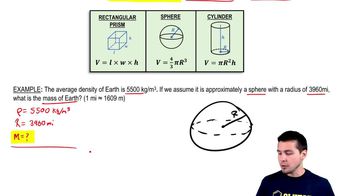
Problems with Mass, Volume, & Density
SI Units
The International System of Units (SI) is the standard system of measurement used in science and engineering. It provides a consistent framework for measuring physical quantities, including mass (kilograms), volume (cubic meters), and density (kilograms per cubic meter). Familiarity with SI units is essential for accurate calculations and comparisons in physics.
Recommended video:
Guided course
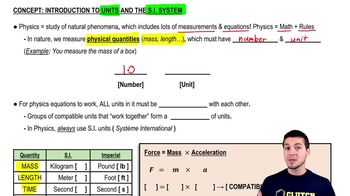
Introduction to Units & the SI System
Volume Calculation
Volume is the amount of space occupied by an object and is a critical component in calculating mass density. For irregular shapes, volume can be determined through methods such as water displacement, while regular shapes use geometric formulas. In this question, the volume of the solid is given in cubic centimeters, which must be converted to cubic meters to align with SI units for density calculations.
Recommended video:
Guided course
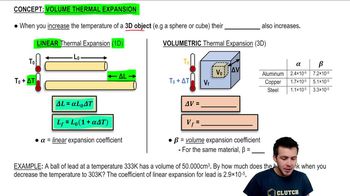
Volume Thermal Expansion
Related Practice
Textbook Question
1782
views
Textbook Question
A 5.4 cm diameter cylinder has a length of 12.5 cm. What is the cylinder's volume in basic SI units?
2684
views
Textbook Question
As an architect, you are designing a new house. A window has a height between 140 cm and 150 cm and a width between 74 cm and 70 cm. What are the smallest and largest areas that the window could be?
1231
views
Textbook Question
FIGURE P1.58 shows a motion diagram of a car traveling down a street. The camera took one frame every 10 s. A distance scale is provided. Make a position-versus-time graph for the car. Because you have data only at certain instants of time, your graph should consist of dots that are not connected together.
688
views