
Textbook Question
Mark the following statements as true or false. If a statement is false, correct it to make a true statement.
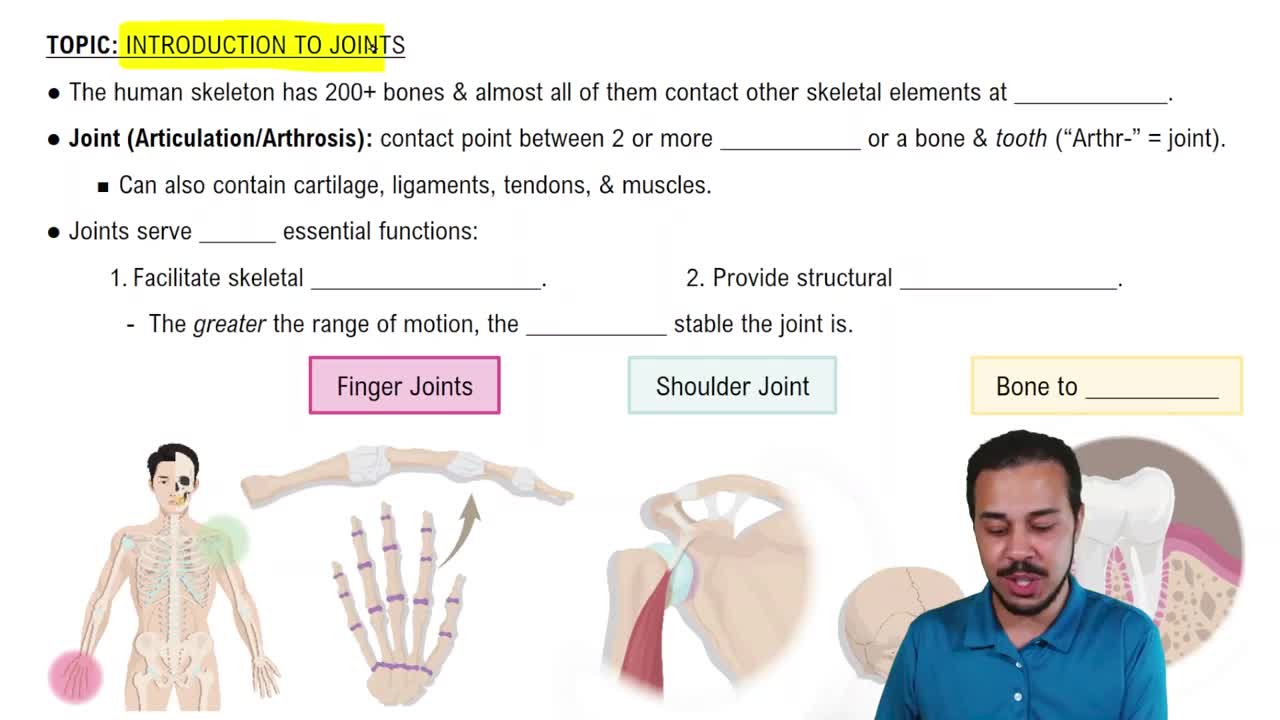
Cartilaginous joints are synarthroses.
926
views

 Verified step by step guidance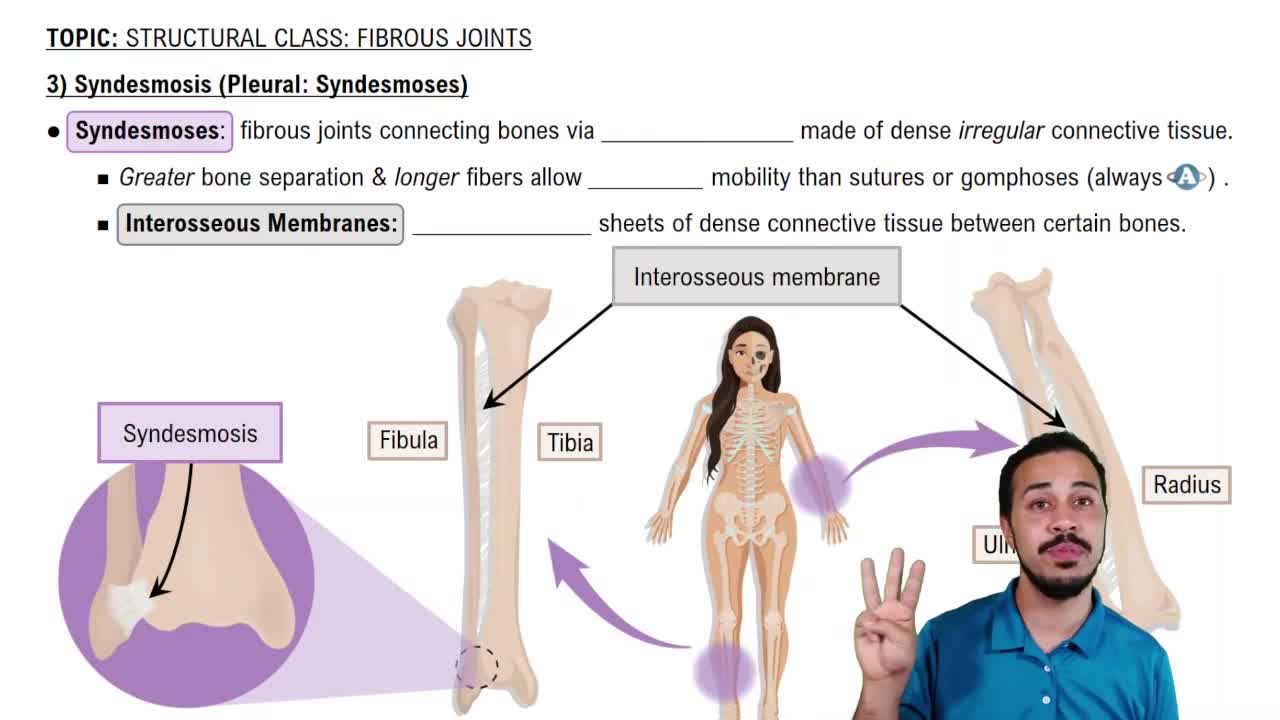
 04:28
04:28
 05:39
05:39 1:46
1:46Mark the following statements as true or false. If a statement is false, correct it to make a true statement.
Cartilaginous joints are synarthroses.
The articulating ends of bones of synovial joints are covered in______. The remaining internal surfaces of the joint are lined by the_____, which produces synovial fluid. The entire joint is encased by the_____, which is composed of dense, irregular collagenous connective tissue.
Mark the following statements as true or false. If a statement is false, correct it to make a true statement.
Fibrous joints are united by collagen fibers.
Identify each of the following joints as synovial, fibrous, or cartilaginous.
a. Pubic symphysis______
b. Elbow joint_____
c. Epiphyseal plate_______
d. Frontal suture_________
e. Gomphosis___________
When articular cartilage is damaged, often fibrocartilage forms instead of new hyaline cartilage. Does fibrocartilage have the same properties as hyaline cartilage? Is it likely to provide the same type of surface as hyaline cartilage? Explain. (Connects to Chapter 4)
What is/are the function(s) of synovial fluid?