
Ch. 12 The Central Nervous System
Amerman - Human Anatomy & Physiology 2nd Edition
Amerman2nd EditionHuman Anatomy & PhysiologyISBN: 9780136873822Not the one you use?Change textbook
Chapter 12, Problem 1

The central nervous system is responsible for:
a. Integrative functions
b. Sensory functions
c. Motor functions
d. Both b and c are correct

Verified step by step guidance
1
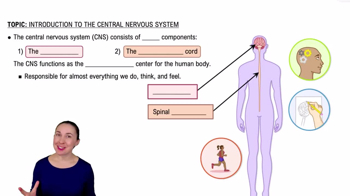
Step 1: Begin by understanding the central nervous system (CNS). The CNS consists of the brain and spinal cord, and its primary role is to process information and coordinate responses.
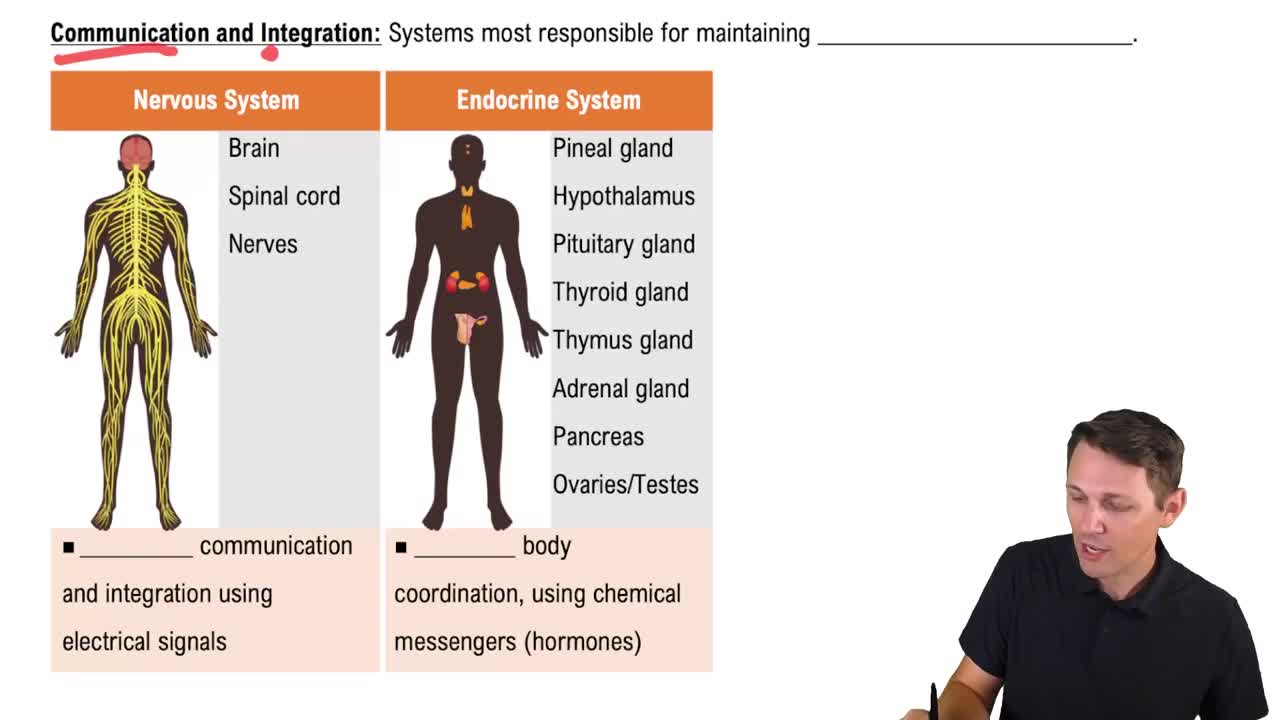
Step 2: Review the functions of the CNS. It is responsible for integrative functions, which involve processing and interpreting sensory input and deciding on motor output.
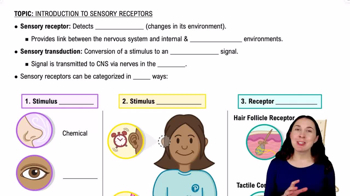
Step 3: Examine sensory functions. Sensory functions involve detecting stimuli from the environment or within the body and transmitting this information to the CNS for processing.
Step 4: Consider motor functions. Motor functions involve sending signals from the CNS to muscles or glands to elicit a response, such as movement or secretion.
Step 5: Analyze the options provided in the question. Determine whether the CNS is responsible for integrative functions, sensory functions, motor functions, or a combination of sensory and motor functions.

Verified video answer for a similar problem:

This video solution was recommended by our tutors as helpful for the problem above.
Was this helpful?

Key Concepts

Here are the essential concepts you must grasp in order to answer the question correctly.

Central Nervous System (CNS)

The central nervous system consists of the brain and spinal cord, serving as the main control center for processing information and coordinating responses. It integrates sensory data, generates thoughts, and directs motor functions, making it essential for all bodily activities.
Recommended video:
1:32
The Central Nervous System

Integrative Functions

Integrative functions refer to the CNS's ability to process and interpret sensory information, allowing for decision-making and response generation. This involves complex neural networks that analyze inputs from various sensory modalities to produce coherent outputs.
Recommended video:
Guided course
02:58
Communication and Integration

Motor and Sensory Functions

Motor functions involve the CNS directing muscle movements, while sensory functions pertain to the reception and processing of external stimuli. Together, these functions enable organisms to interact with their environment, responding appropriately to various stimuli.
Recommended video:
2:47
Sensory Receptors