
Ch. 3 The Cell
Amerman - Human Anatomy & Physiology 2nd Edition
Amerman2nd EditionHuman Anatomy & PhysiologyISBN: 9780136873822Not the one you use?Change textbook
Chapter 3, Problem 6

What is the primary difference between active transport processes and passive transport processes?

Verified step by step guidance
1
Understand that transport processes in cells are mechanisms by which substances move across the cell membrane. These processes are broadly categorized into active and passive transport.
Recognize that passive transport does not require energy (ATP) from the cell. Instead, it relies on the natural movement of molecules down their concentration gradient, from an area of high concentration to an area of low concentration. Examples include diffusion, osmosis, and facilitated diffusion.
Understand that active transport requires energy in the form of ATP because it moves substances against their concentration gradient, from an area of low concentration to an area of high concentration. Examples include the sodium-potassium pump and endocytosis.
Note that the key difference lies in energy usage: passive transport is energy-independent, while active transport is energy-dependent.
Consider the physiological significance: passive transport is efficient for processes like gas exchange, while active transport is crucial for maintaining concentration gradients essential for cellular functions, such as nerve impulse transmission.

Verified video answer for a similar problem:

This video solution was recommended by our tutors as helpful for the problem above.
Was this helpful?

Key Concepts

Here are the essential concepts you must grasp in order to answer the question correctly.

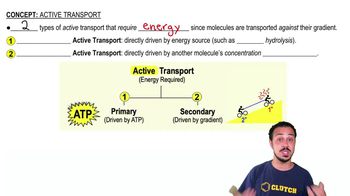
Active Transport

Active transport is a cellular process that requires energy, usually in the form of ATP, to move molecules against their concentration gradient. This means substances are transported from areas of lower concentration to areas of higher concentration, which is essential for maintaining cellular homeostasis and nutrient uptake.
Recommended video:
02:37
Active Transport

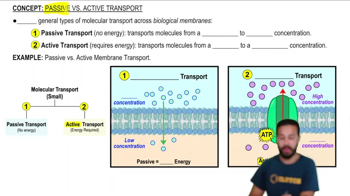
Passive Transport

Passive transport is the movement of molecules across a cell membrane without the use of energy. This process relies on the natural kinetic energy of molecules and occurs along the concentration gradient, meaning substances move from areas of higher concentration to areas of lower concentration, such as in diffusion and osmosis.
Recommended video:
05:05
Passive vs. Active Transport

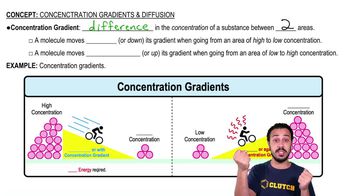
Concentration Gradient

A concentration gradient refers to the difference in the concentration of a substance between two areas. It is a driving force for both active and passive transport processes, as substances tend to move from regions of higher concentration to lower concentration in passive transport, while active transport moves substances against this gradient.
Recommended video:
04:51
Concentration Gradients and Diffusion
Related Practice
Textbook Question

Match the term with its appropriate definition. 

Osmosis    

Secondary active transport    

Exocytosis    

Phagocytosis    

Simple diffusion    

Primary active transport    

Pinocytosis    

Facilitated diffusion

a. Type of endocytosis in which a large particle is ingested

b. Transport across the plasma membrane against the concentration gradient via direct use of energy from ATP

c. Passive movement of solute across the plasma membrane

d. Movement of solvent from a solution of lower solute concentration to a solution of higher solute concentration

e. Passive movement of solute across the plasma membrane via a channel or carrier protein

f. Type of endocytosis in which ECF is brought into the cell in a protein-coated pit

g. Release of large substances from the cell through a vesicle

h. Transport of a substance across the plasma membrane against its concentration gradient using the energy from the 'downhill' movement of another substance

649
views
Textbook Question

Mark the following statements about the plasma membrane as true or false. If a statement is false, correct it to make a true statement.

Membrane proteins often function as channels or carriers.

666
views
Textbook Question

Mark the following statements about the plasma membrane as true or false. If a statement is false, correct it to make a true statement.

Membrane cholesterol is vital for cell-cell recognition.

601
views
Textbook Question

Match the following terms with the correct functions.

Peroxisome     

Ribosome     

Smooth endoplasmic reticulum     

Mitochondrion     

Golgi apparatus     

Lysosome     

Rough endoplasmic reticulum     

Vesicle

a. Modifies and folds proteins into the correct structure

b. Modifies, packages, and sorts proteins

c. Contains digestive enzymes

d. Granular organelle that makes proteins

e. Synthesizes most of a cell’s ATP

f. Contains enzymes that oxidize toxins and fatty acids

g. Membrane-enclosed structure used to transport substances through the cell

h. Detoxifies certain chemicals, makes lipids, stores calcium ions

48
views
Textbook Question

Mark the following statements about the plasma membrane as true or false. If a statement is false, correct it to make a true statement.

The overall structure of the plasma membrane is a mosaic with the components locked tightly in place.

564
views
Textbook Question

A hypotonic solution will cause water to move ________the cell, and the cell will ______.

A hypertonic solution will cause water to move ______the cell, and the cell will ________.

758
views