Pearson+ LogoPearson+ Logo
Ch. 14 The Autonomous Nervous System and Homeostasis
Amerman - Human Anatomy & Physiology 2nd Edition
Erin C. Amerman2nd EditionHuman Anatomy & PhysiologyISBN: 9780136873822Not the one you use?Change textbook
Chapter 14, Problem 3

Sympathetic preganglionic neurons synapse:


a. directly on target cells.
b. on skeletal muscle fibers.
c. on sympathetic chain or collateral ganglia.
d. on vagal ganglia.

Verified step by step guidance
1
Understand the role of sympathetic preganglionic neurons in the autonomic nervous system. These neurons originate in the thoracolumbar region of the spinal cord and are part of the sympathetic division, which is responsible for the 'fight or flight' response.
Recall that preganglionic neurons do not directly innervate target cells. Instead, they synapse with postganglionic neurons, which then innervate the target cells or organs.
Identify the location where sympathetic preganglionic neurons synapse. They typically synapse in ganglia, which are clusters of neuronal cell bodies located outside the central nervous system.
Differentiate between the types of ganglia in the sympathetic division. Sympathetic preganglionic neurons synapse either in the sympathetic chain ganglia (paravertebral ganglia) or in collateral ganglia (prevertebral ganglia). These ganglia are strategically located to relay signals to various target organs.
Eliminate incorrect options based on anatomical knowledge: (a) is incorrect because preganglionic neurons do not directly synapse on target cells; (b) is incorrect because skeletal muscle fibers are controlled by the somatic nervous system, not the autonomic nervous system; (d) is incorrect because vagal ganglia are associated with the parasympathetic division, not the sympathetic division.

Verified video answer for a similar problem:

This video solution was recommended by our tutors as helpful for the problem above.
Was this helpful?

Key Concepts

Here are the essential concepts you must grasp in order to answer the question correctly.

Sympathetic Nervous System

The sympathetic nervous system is a part of the autonomic nervous system responsible for the body's 'fight or flight' response. It prepares the body for stressful situations by increasing heart rate, dilating pupils, and redirecting blood flow to essential organs. Understanding its role is crucial for analyzing how sympathetic preganglionic neurons function.
Recommended video:
1:21
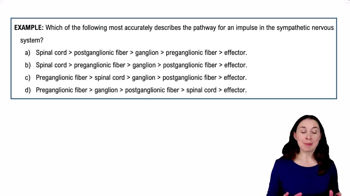
Sympathetic Nervous System Example 3

Preganglionic Neurons

Preganglionic neurons are the first neurons in the autonomic nervous system pathway, originating in the central nervous system and synapsing with postganglionic neurons in ganglia. In the sympathetic nervous system, these neurons typically synapse in the sympathetic chain or collateral ganglia, which is essential for understanding their role in transmitting signals to target organs.
Recommended video:

Ganglia

Ganglia are clusters of nerve cell bodies located outside the central nervous system. In the context of the sympathetic nervous system, they serve as relay points where preganglionic neurons synapse with postganglionic neurons. This concept is vital for understanding the pathways through which sympathetic signals are transmitted to various target tissues.
Recommended video:
2:37
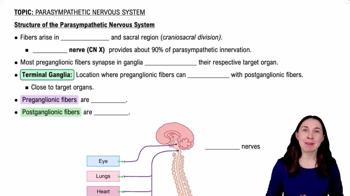
Structure of the Parasympathetic Nervous System