Ch. 18 The Cardiovascular System II: The Blood Vessels
Amerman - Human Anatomy & Physiology 2nd Edition
Erin C. Amerman2nd EditionHuman Anatomy & PhysiologyISBN: 9780136873822Not the one you use?Change textbook
Chapter 18, Problem 15

The hydrostatic pressure gradient drives water _____ capillaries, and the colloid osmotic pressure draws water ____ capillaries.
a. out of; out of
b. out of; into
c. into; out of
d. into; into

Verified step by step guidance
1
Understand the concept of hydrostatic pressure: Hydrostatic pressure is the force exerted by a fluid due to its weight. In the context of capillaries, it pushes water and solutes out of the capillaries into the surrounding interstitial space.
Understand the concept of colloid osmotic pressure: Colloid osmotic pressure, also known as oncotic pressure, is generated by plasma proteins (like albumin) in the blood. It pulls water back into the capillaries from the interstitial space.
Analyze the relationship between these pressures: Hydrostatic pressure and colloid osmotic pressure work in opposite directions. Hydrostatic pressure drives water out of the capillaries, while colloid osmotic pressure draws water into the capillaries.
Apply this understanding to the question: The hydrostatic pressure gradient drives water out of the capillaries, and the colloid osmotic pressure draws water into the capillaries.
Review the answer choices: Based on the explanation, the correct answer is 'b. out of; into,' as hydrostatic pressure pushes water out and colloid osmotic pressure pulls water in.

Verified video answer for a similar problem:

This video solution was recommended by our tutors as helpful for the problem above.
Was this helpful?

Key Concepts

Here are the essential concepts you must grasp in order to answer the question correctly.

Hydrostatic Pressure Gradient

The hydrostatic pressure gradient refers to the pressure exerted by a fluid at rest due to the force of gravity. In the context of capillaries, this pressure drives water out of the capillaries into the surrounding tissues, facilitating the exchange of nutrients and waste products. Understanding this concept is crucial for analyzing fluid movement in the circulatory system.
Recommended video:
04:51
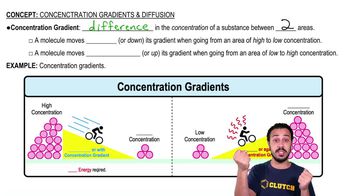
Concentration Gradients and Diffusion

Colloid Osmotic Pressure

Colloid osmotic pressure is the pressure exerted by proteins, primarily albumin, in the blood plasma that attracts water into the capillaries. This pressure counteracts hydrostatic pressure and is essential for maintaining fluid balance within the vascular system. It plays a key role in determining the direction of water movement across capillary membranes.
Recommended video:
Guided course
6:12
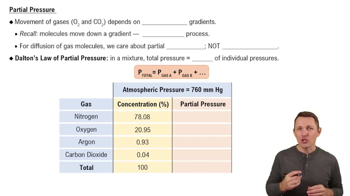
Partial Pressure

Capillary Dynamics

Capillary dynamics involves the processes that govern the movement of fluids and solutes across capillary walls. It is influenced by both hydrostatic and colloid osmotic pressures, which together determine whether water moves into or out of the capillaries. A solid grasp of these dynamics is necessary for understanding physiological processes such as tissue perfusion and edema.
Recommended video:
4:36
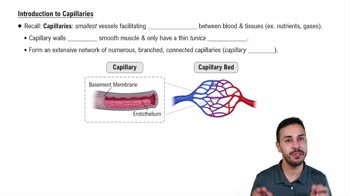
Introduction to Capillaries
Related Practice
Textbook Question

Mark the following statements as true or false. If a statement is false, correct it to make a true statement.

Increased concentrations of carbon dioxide and hydrogen ions and a decreased concentration of oxygen in the interstitial fluid cause local arteriolar constriction.

523
views
Textbook Question

Mark the following statements as true or false. If a statement is false, correct it to make a true statement.

The increase in tissue perfusion in skeletal muscle that occurs during exercise is known as hyperemia.

478
views
Textbook Question

Mark the following statements as true or false. If a statement is false, correct it to make a true statement.

The sympathetic nervous system causes vasodilation in the skin when body temperature decreases.

623
views
Textbook Question

Match the following arteries with the correct description. 

__Radial artery      

__Celiac trunk      

__Basilar artery       

__Superior mesenteric artery      

__Dorsalis pedis artery      

__Femoral artery      

__Internal iliac artery      

__Renal artery      

__Internal carotid artery      

__Subclavian artery

a. Supplies the small intestine and most of the large intestine 

b. Supplies the pelvis 

c. Supplies the upper limb 

d. Located in the lateral forearm 

e. Provides the blood supply to the lower limb 

f. Supplies the brain via the anterior and middle cerebral arteries 

g. Large single branch off the aorta that supplies the liver, stomach, duodenum, and spleen 

h. Supplies the foot and ankle 

i. Supplies the kidney 

j. Forms from the fusion of the two vertebral arteries 

563
views
Textbook Question

Which of the following is not a common pulse point?

a. Femoral artery

b. Subclavian artery

c. Common carotid artery

d. Brachial artery

724
views
Textbook Question

Which of the following vessels does not drain into the hepatic portal vein?

a. Splenic vein

b. Inferior mesenteric vein

c. Gastric vein

d. Renal vein

e. Superior mesenteric vein

600
views
1
rank